


I. What are Medium and Heavy Plates?
Medium and heavy plates are steel plates with a thickness of 4.5mm or greater. They are among the most important types of plate materials within the four major categories of steel products (plates, pipes, sections, and wires).
Official Definition: According to the National Standard of the People's Republic of China, GB/T 2970-2016 "Thick Steel Plates-Method for Ultrasonic Testing", steel plates are typically categorized as follows:
- Medium Plates: Thickness between 4.5mm and 25.0mm.
- Heavy Plates: Thickness between 25.0mm and 60.0mm.
- Extra-thick Plates: Thickness > 60.0mm.
Industry Practice: In actual production and trade, people commonly refer to medium, heavy, and extra-thick plates collectively as "Medium and Heavy Plates," specifically meaning any steel plate with a thickness≥4.5mm.
II. Classification of Medium and Heavy Plates
Medium and heavy plates can be classified in various ways.
The most common methods include:
1. Classification by Thickness:
Medium Plates: 4.5 to 25mm
Heavy Plates: 25 to 60mm
Extra-thick Plates: > 60mm
2. Classification by Application (The core classification method):
- Steel for Pressure Vessels: Such as Q245R, Q345R, 14Cr1MoR, etc. These require high-temperature strength, good plasticity/toughness, and excellent weldability.
- Steel for Boilers: Such as Q245R, Q370R, 15CrMoR, etc. These require high-temperature creep rupture strength and creep resistance.
- Wear-resistant Steel: Such as NM360, NM400, NM500, etc., featuring extremely high surface hardness and superior wear performance.
- Weathering Steel: Such as Q355NH, Q415NH. By adding elements like copper, phosphorus, and chromium, a dense protective film is formed on the surface to resist atmospheric corrosion.
- High-strength Steel: Such as quenched and tempered Q550D, Q690D, Q890D, or higher strength grades, used in critical parts of construction machinery and mining equipment.
- Carbon Structural Steel: Such as Q235B, Q355B, etc.
- Low-alloy High-strength Structural Steel: Such as Q390, Q420, Q460, etc., which offer improved strength and toughness.
- Bridge Steel: Such as Q345q, Q420q, etc. These require good low-temperature impact toughness, weldability, and weather resistance.
- Shipbuilding Structural Steel: Such as A, B, D, E, AH32, DH36, etc. These are divided by strength levels and toughness (quality grades) and require excellent corrosion resistance and weldability.
- Steel for Building Structures: Such as Q235GJ, Q345GJ, etc., which feature superior seismic performance.
- General Structural Steel: Used for manufacturing buildings, bridges, ships, vehicles, and mechanical structures.
3. Classification by Material (Chemical Composition):
- Common Carbon Steel
- High-quality Carbon Structural Steel (e.g., 45# steel)
- Low-alloy High-strength Steel
- Alloy Structural Steel
4. Classification by Production Process / Delivery Status:
- Hot Rolled (HR): Delivered directly after rolling; standard performance.
- Normalizing (N): Normalizing heat treatment is performed after rolling to refine grain size and improve mechanical properties and machining performance.
- Normalized Rolling (NR): A controlled rolling process where the performance reaches the normalized state; it can replace some normalized plates.
- Quenched and Tempered (Q): Quenching followed by high-temperature tempering to obtain extremely high strength combined with good toughness.
- TMCP (Thermo-Mechanical Control Process): An advanced production process that achieves superior comprehensive properties by precisely controlling the rolling temperature and cooling process.
III. Production Process Flow of Medium and Heavy Plates
Modern production of medium and heavy plates primarily follows the process of "Steelmaking → Continuous Casting → Rolling → Finishing."
- Steelmaking and Continuous Casting: Molten iron is smelted in converters or electric furnaces. After refining, it is cast into large slabs via a continuous casting machine.
- Heating: Slabs are heated in a walking-beam reheating furnace to approximately 1200°C to ensure uniform heating and reach a plastic state.
- Rolling: This is the core stage, divided into two phases:
- Rough Rolling: Removing the iron oxide scale from the slab surface and rolling it to the required width and a specific thickness.
2.Finish Rolling: Precisely controlling the thickness, plate shape, and properties to reach the target dimensions. Modern rolling mills utilize ACC (Accelerated Cooling) systems to control cooling rates online and optimize performance.
- Cooling and Straightening: After rolling, the steel plates are cooled to room temperature on a cooling bed and then straightened by a straightening machine to eliminate internal stress and shape defects.
- Defect Detection and Inspection:
Ultrasonic Testing (UT): Detecting internal defects such as delamination and inclusions within the steel plate.
Visual and Dimensional Inspection: Checking length, width, thickness, flatness, etc.
- Heat Treatment (Optional): Processes such as normalizing or quenching and tempering are conducted in heat treatment furnaces as required.
- Shearing/Cutting: Based on order requirements, the steel plates are sheared to final dimensions using double-side shears or rotary shears.
- Marking, Identification, and Warehousing.
IV. Main Technical Standards and Grades
- Chinese National Standards (GB): Such as GB/T 3274 (Carbon structural steel and low-alloy steel), GB/T 712 (Shipbuilding plates), and GB 713 (Pressure vessel plates).
- American Standards (ASTM): Such as A36 (General purpose plate), A572 (High-strength plate), and A516 (Pressure vessel plate).
- European Standards (EN): Such as S235JR, S355J2, and P355GH.
- Japanese Industrial Standards (JIS): Such as SS400, SM400A, and SM490YA.
- International Standards (ISO).
Examples of Common Grades:
- Q235B: The most commonly used carbon structural steel, with a yield strength≥235MPa.
- Q355B: Replacing the old grade Q345B, it is the most common low-alloy high-strength steel, with a yield strength≥355MPa.
- Q345R: The most commonly used pressure vessel plate.
- AH36: A common shipbuilding plate, with a yield strength≥355MPa.
V. Main Application Areas of Medium and Heavy Plates
Medium and heavy plates are known as the "Skeleton of the Industry" and are used extremely widely:
- Construction Industry: Steel structure beams and columns for high-rise buildings, stadiums, and industrial plants.
- Bridge Construction: Bridge decks, trusses, and pier bodies for railway and highway bridges.
- Shipbuilding and Marine Engineering: Ship decks, bulkheads, bulbous bows, and offshore oil drilling platforms.
- Machinery Manufacturing: Mining machinery, construction machinery (excavators, cranes), power generation equipment, and the frames and structural components of large machine tools.
- Pressure Vessels: Storage tanks, reactors, boiler drums, and nuclear power equipment in the petrochemical sector.
- Pipeline Transportation: Used for manufacturing large-diameter, high-pressure oil and gas transmission pipelines.
- Military Industry: Tank armor, naval vessel armor, etc.
Precautions for Purchasing Medium and Heavy Plates
- Clearly Define Requirements: Be clear about the required steel grade, specifications (thickness × width × length), quantity, technical standards, and delivery status (e.g., whether normalizing or ultrasonic testing is required), among other details.
- Select Reputable Suppliers: Quality is better guaranteed when dealing with large steel mills or their primary agents.
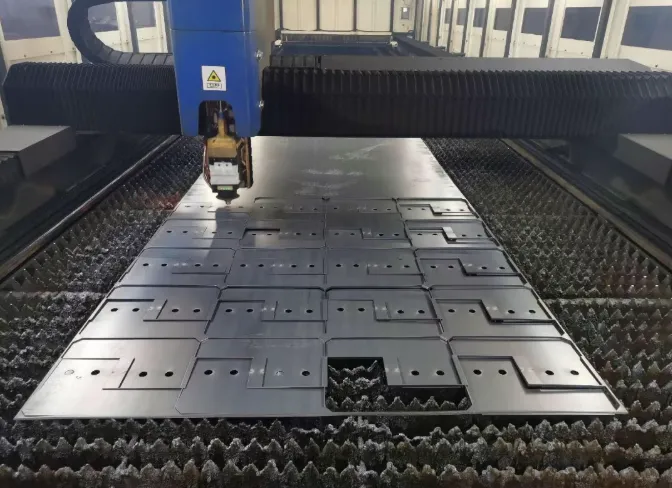
For example, GNEE STEEL exports medium and heavy plates year-round and is equipped with double-sided bevel laser cutting machines and flame cutting machines.
We also offer services such as welding, bending, pipe cutting, and rolling, and are capable of processing various products including medium and heavy plates, hot-rolled coils, stainless steel, and aluminum.
Stop Sourcing Blindly: The 6-Step Checklist for Buying Flaw-Free Heavy Plates.
- Verify Mill Test Certificates (MTC/CofC): This is the "ID card" of the steel plate. It should clearly state the heat/lot number, grade, specifications, mechanical properties, chemical composition, and executive standards. You should also verify that this information matches the markings on the actual product.
- Visual Inspection: Observe the surface to check for defects such as severe corrosion, pitting, scratches, or cracks.
- Dimensional Verification: Conduct sample measurements of the thickness, width, and length to ensure they are within the specified tolerance range.
- Conduct Third-party Inspection if Necessary: For major engineering projects, third-party testing organizations (such as SGS, BV, etc.) can be commissioned to perform on-site sampling and testing.


