


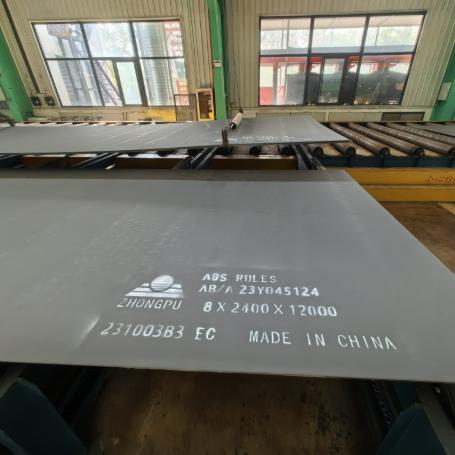


What is a Shipbuilding Steel Plate?
Shipbuilding steel plate is a specialized form of structural steel that is specifically developed for use in ship construction and repair. It is engineered to withstand the harsh marine environment, including exposure to saltwater, humidity, and varying temperatures. This steel plate must meet stringent criteria regarding strength, tensile properties, impact resistance, and fatigue resistance to ensure the safety and durability of ships at sea.
ABS MTC

BV MTC

Benefits of Shipbuilding Steel Plate
 Strength and durability
Shipbuilding steel plates are specifically designed to withstand the harsh conditions at sea. They are made with a high-strength material that can withstand the impact, pressure, and vibrations encountered during the ship's operation. This ensures the structural integrity of the vessel, making it safe and capable of withstanding rough weather and heavy loads.
Corrosion resistance
Shipbuilding steel plates are treated with various coatings and anti-corrosion materials to protect them from the corrosive effects of seawater, salt, and atmospheric conditions. This significantly extends the lifespan of the ship, reducing maintenance and repair costs.
Weldability
Shipbuilding steel plates have excellent weldability, allowing for efficient and strong joints. This enables shipbuilders to construct complex structures and secure different parts of the ship together without compromising its strength.
Lightweight
Shipbuilding steel plates are designed to be both strong and lightweight. This is crucial for ships as it helps improve their fuel efficiency and overall performance. The reduced weight allows ships to carry larger cargo loads, increasing their profitability.
 Fire resistance
Shipbuilding steel plates are often coated with fire-resistant materials and have inherent fire-resistant properties. This is crucial for the safety of the crew and passengers, as fires at sea can be catastrophic. The fire-resistant properties of shipbuilding steel plates help contain and prevent the rapid spread of fire, buying time for proper evacuation and firefighting measures.
Easy maintenance
Shipbuilding steel plates require minimal maintenance compared to other materials used in ship construction. They are easy to clean, resistant to wear and tear, and provide a smooth surface that reduces friction and drag, maximizing the ship's maneuverability and efficiency.
Availability and cost-effectiveness
Shipbuilding steel plates are readily available in the market, making them a cost-effective choice for shipbuilders. They offer a high return on investment due to their durability, longevity, and low maintenance requirements.
If you want to learn about the specific grades of shipbuilding steel plates, you can click on the Shipbuilding Steel Plates Product Page.
Types of Shipbuilding Steel Plate
 Mild Steel Plate: Mild steel is a low carbon steel that is easy to weld and form. It is commonly used in shipbuilding due to its excellent strength and durability. Mild steel plates are suitable for various shipbuilding applications, such as hull structure, deck machinery, and offshore oil platforms.
High-strength Steel Plate: High-strength steel plates are known for their exceptional mechanical properties and are used in shipbuilding to enhance the ship's structural integrity. These plates are made from alloys that offer superior strength, such as AH36, DH36, EH36, and FH36. High-strength steel plates ensure the safety and reliability of the ship even in harsh marine environments.
Steel Plate for Offshore Platforms: Offshore platforms require specialized steel plates that can withstand extreme weather conditions and corrosive environments. These plates are made from corrosion-resistant alloys, which offer excellent strength and durability. Steel plates for offshore platforms are used in the construction of oil rigs, drilling platforms, and other offshore structures.
 Stainless Steel Plate: Stainless steel plates are highly resistant to corrosion and are widely used in shipbuilding, especially for vessels that transport or handle corrosive substances. These plates are made from alloys that contain a high percentage of chromium, which provides excellent resistance against rust and corrosion. Stainless steel plates are used in various shipbuilding applications, including tanks, pipes, and fittings.
Aluminum Alloy Plate: Although not strictly steel, aluminum alloy plates are also used in shipbuilding, particularly for lightweight and high-speed vessels. Aluminum alloy plates provide excellent corrosion resistance and high strength-to-weight ratio, making them ideal for ship structures that require reduced weight without compromising strength. These plates are used in the construction of fast ferries, patrol boats, and other lightweight vessels.
If you want to learn about the specific grades of shipbuilding steel plates, you can click on the Shipbuilding Steel Plates Product Page.
Application of Shipbuilding Steel Plate

Shipbuilding industry
① Shipbuilding steel plates are extensively used in the shipbuilding industry for the construction of hulls and other structural components of various types of vessels.
② These plates are crucial for providing strength, durability, and resistance to corrosion, making them ideal for building ships that can withstand harsh marine environments.
③ Shipbuilding steel plates are used in the construction of both commercial and naval vessels, including cargo ships, tankers, container ships, cruise ships, submarines, and aircraft carriers.
Offshore industry
① Shipbuilding steel plates find extensive application in the offshore industry for the construction of offshore structures, such as offshore drilling rigs, offshore platforms, and offshore wind turbines.
② These plates are designed to withstand extreme weather conditions, high levels of corrosion, and heavy loads experienced in offshore environments.
③ Shipbuilding steel plates used in the offshore industry are known for their high tensile strength, excellent weldability, and resistance to fatigue and impact.


Oil and gas industry
① Shipbuilding steel plates are utilized in the oil and gas industry for the fabrication of various equipment and structures used in oil refineries, petrochemical plants, and offshore oil rigs.
② These plates are suitable for constructing storage tanks, pressure vessels, pipelines, and structural components that need to withstand high-pressure and high-temperature conditions.
③ Shipbuilding steel plates used in the oil and gas industry undergo stringent quality control measures and must meet specific requirements for toughness, hardness, and chemical composition.
Construction industry
① Shipbuilding steel plates are also employed in the construction industry for various applications, such as the fabrication of bridges, cranes, and machinery.
② These plates offer excellent strength and durability, making them useful in heavy construction projects that require structural integrity and load-bearing capacity.
③ Shipbuilding steel plates used in the construction industry are often hot-rolled and can be further processed for specific applications, such as bending, shaping, and welding.

If you want to learn about the specific grades of shipbuilding steel plates, you can click on the Shipbuilding Steel Plates Product Page.
Process of Shipbuilding Steel Plate
01.
Material selection
The first step in shipbuilding steel plate is to select the appropriate material. The material should have high strength, good corrosion resistance, and the ability to withstand harsh marine environments.
02.
Cutting and shaping
Once the material is selected, the shipbuilding steel plate is cut into the desired shape and size. This is often done using automated cutting machines, such as plasma or laser cutting, to ensure precision and accuracy.
03.
Rolling and forming
After cutting, the shipbuilding steel plate is rolled and formed into the desired shape, such as flat sheets or curved plates. This is achieved through hot or cold rolling processes, which involve passing the plate through a series of rollers to achieve the desired thickness and shape.
04.
Welding and joining
Shipbuilding steel plates are often joined together through welding. The plates are aligned and welded together using various welding techniques, such as arc welding or gas welding, to create a strong and durable structure.
05.
Surface treatment
Once the welding is complete, the shipbuilding steel plates undergo surface treatment to improve their corrosion resistance and appearance. This may involve cleaning, degreasing, and applying protective coatings, such as paint or zinc coating, to prevent corrosion and maintain the integrity of the plates.
06.
Quality control
Throughout the process, strict quality control measures are implemented to ensure that the shipbuilding steel plates meet the required standards and specifications. This includes regular inspections, testing, and documentation of the materials and processes used.
07.
Inspection and certification
Once the shipbuilding steel plates are manufactured, they undergo rigorous inspection and certification processes to ensure their compliance with industry standards and regulations. This is done by authorized bodies, such as classification societies, who verify the quality and safety of the plates.
08.
Delivery and installation
Finally, the shipbuilding steel plates are ready for delivery and installation. They are transported to the shipyard or construction site, where they are installed and integrated into the ship's structure. This involves careful planning and coordination to ensure the plates are positioned correctly and securely.
If you want to learn about the specific grades of shipbuilding steel plates, you can click on the Shipbuilding Steel Plates Product Page.
How to Choose Shipbuilding Steel Plate
Understand the requirements
The first step is to understand the specific requirements of your shipbuilding project. Consider factors such as the size and type of the vessel, the operating conditions it will be subjected to, and any industry regulations or standards that need to be met.
Strength and durability
Shipbuilding steel plates need to have high strength and durability to withstand the harsh marine environment. Look for plates with a high tensile strength and good impact resistance. It should also have excellent weldability, as welding is a crucial process in shipbuilding.
Corrosion resistance
Ships are constantly exposed to moisture and saltwater, leading to the risk of corrosion. Therefore, choose a steel plate that has good corrosion resistance properties. Stainless steel plates are often preferred for their superior resistance to corrosion.
If you want to learn more about GNEE's products, you can send an email to ship@gescosteel.com. We are more than happy to assist you.
If you want to learn about the specific grades of shipbuilding steel plates, you can click on the Shipbuilding Steel Plates Product Page.
FAQ
What are shipbuilding steel plates?
Shipbuilding steel plates are specialized structural steel plates designed specifically for manufacturing hulls and other marine structures. They are produced in accordance with classification society standards (e.g., CCS, ABS, LR) to ensure they can withstand the harsh marine environment, including saltwater corrosion, extreme temperatures, and mechanical stresses .
What are the main grades of shipbuilding steel plates?
1. General-strength grades (yield strength ≥ 235 MPa):
A: Normal temperature toughness (20°C)
B: Better toughness (0°C)
D: Low-temperature toughness (-20°C)
E: Enhanced low-temperature toughness (-40°C)
2. High-strength grades (yield strength ≥ 315 MPa):
AH32/36/40: Normal temperature toughness (0°C)
DH32/36/40: Low-temperature toughness (-20°C)
EH32/36/40: Enhanced low-temperature toughness (-40°C)
FH32/36/40: Extreme low-temperature toughness (-60°C)
Naming convention:
First letter: A (ordinary), D (low-temp), E (enhanced low-temp), F (extreme low-temp)
"H": High strength
Numbers: Yield strength in kgf/mm² × 10 (e.g., "36" = 355 MPa)
What are the typical specifications?
Thickness: 2.5-200 mm (most common: 4-50 mm)
Width: 1,200-4,200 mm GNEE
Length: 3,000-25,000 mm GNEE
Surface finish: Hot-rolled, normalized, or controlled-rolled
What are the key mechanical properties?
General-strength steel (e.g., Grade B):
Yield strength: ≥ 235 MPa
Tensile strength: 400-520 MPa
Elongation: ≥ 22%
Impact energy: ≥ 27 J at specified temperature
High-strength steel (e.g., AH36):
Yield strength: ≥ 355 MPa
Tensile strength: 490-620 MPa
Elongation: ≥ 20%
Impact energy: ≥ 34 J at specified temperature
What are the main applications?
Hull construction (main structural components)
Decks and superstructures
Bulkheads and partitions
Offshore platforms
Marine equipment and components
How to choose the right grade?
Key selection criteria:
Operating temperature:
Tropical waters: AH32/36
Temperate zones: DH32/36
Arctic regions: EH32/36 or FH32/36
Structural requirements:
General hull: A/B/D/E grades
Heavy-duty structures: AH/DH/EH/FH grades
Ice-class vessels: EH/FH grades
Ship size and type:
Small vessels: A/B grades
Large commercial ships: AH36/DH36
Polar-class ships: FH40
What certifications are required?
Shipbuilding steel plates must be certified by recognized classification societies, including:
CCS (China Classification Society)
ABS (American Bureau of Shipping)
DNV GL (Det Norske Veritas)
LR (Lloyd's Register)
BV (Bureau Veritas)
Certification process:
Manufacturer undergoes quality system assessment
Raw materials and production processes are monitored
Each batch is tested for chemical composition and mechanical properties
Certified products carry the classification society's stamp
What are the main quality control tests?
1. Chemical composition analysis:
Carbon (C): ≤0.18% (high-strength grades)
Manganese (Mn): 0.90-1.60% (high-strength grades)
Phosphorus (P)/Sulfur (S): ≤0.025%
Trace elements (Nb, V, Ti): Micro-alloying for enhanced properties
2. Mechanical tests:
Tensile test: Measures yield and tensile strength, elongation
Impact test: Determines toughness at specified temperatures (V-notch)
Bend test: Verifies formability and weld quality
3. Non-destructive testing:
Ultrasonic testing: Detects internal defects
Magnetic particle testing: Identifies surface cracks
What are the advantages of high-strength shipbuilding steel?
Weight reduction: Higher strength allows thinner plates, reducing overall vessel weight
Fuel efficiency: Lighter weight leads to lower fuel consumption
Increased payload capacity: More cargo can be carried
Superior toughness: Better resistance to impact and fatigue in harsh conditions
What are the differences between AH36, DH36, and EH36?
AH36: Standard high-strength steel for normal temperatures (0°C)
DH36: Improved low-temperature toughness (-20°C), suitable for cold regions
EH36: Enhanced low-temperature toughness (-40°C), ideal for Arctic conditions
Note: All three have the same yield strength (355 MPa) but differ in impact performance at various temperatures .
What is the difference between general-strength and high-strength shipbuilding steel?
General-strength: Yield strength ≥ 235 MPa, used for standard applications
High-strength: Yield strength ≥ 315 MPa, used for critical structures requiring higher strength-to-weight ratio
Key application difference: High-strength steel is preferred for large vessels, offshore platforms, and ice-class ships .
How to ensure quality when purchasing shipbuilding steel plates?
Important steps:
Verify certification: Ensure plates have valid classification society certification (e.g., CCS, ABS)
Check documentation: Request Material Test Certificate (MTC) with complete chemical and mechanical test results
Inspect physical appearance: Check for surface defects, proper dimensions
Source from reputable manufacturers: Choose established producers with proven track records
Relying on many first-class equipment, such as CNC Shearing machine, Press Brake machine, Straightening machine, Roll Bending machine, Flat Bar Machine, Deburring machine etc, GNEE STEEL could provide various semi-productsand extensive forming services to customers.
GNEE STEEL PROCESSING


1.CTL & SL SERVICE (141 SETS)
Currently, GNEE STEEL has imported manyadvanced CTL/SL equipment from Italy and Korea and could provide customized CTL/SL services from cold rolled stainless steel and carbon steel to hot rolled stainless steel and carbon steel as well as strips and ultra-wide sheet.
CTL FACILITIES
Max Length:16500mm
Max Width:2200mm
Max Thickness:25.4mm
Max Yield Strength:1500Mpa
SL FACILITIES
Max Width:2200mm
Max Thickness:18mm
Max slit Quantity:31
Max Yield Strength:1200Mpa


2.CUTTING SERVICE
GNEE STEEL imported lots of advanced cutting machines from Germany, Sweden, America and Japan, including plasmas cutting machine, water jet cutting machine, laser cutting machine, flame cutting machine and saw machine. In order to meet customers' diversified needs, GNEE STEEL also adopts nest working multi-cutting methods and intensive production to improve production capacity and save costs for the customers.
Laser Cutting Machine
Max Cutting Length:40,000mm
Max Width:4,600mm
Max Thickness:100mm
Flame Cutting Machine
Max Cutting Length:40,000mm
Max Width:8,000mm
Max Thickness:500mm

Plasmas Cutting Machine
Max Cutting Length:30,000mm
Max Width:5,000mm
Max Thickness:100mm
Water-jet Cutting
Max Cutting Length:12,000mm
Max Width:4,010mm
Max Thickness:250mm

3.FORMING SERVICE
Steel Plate Roll Bending
Maximum Rolling Thickness: up to 200mm
Maximum Width: 4200mm


Automatic Bending Machine-Press Brake
Max Bending Capability:3000Ton
Max Bending Length:15,000mm
Expert in Bending High-Strength & Wear-Resistant Steels


Punching Machine
Max Width:3,070mm
Max Thickness:8mm
Max Pressure:250t

BEVELING SERVICE
GNEE STEEL beveling platform has edge milling machine, edge planer, flame / plasma groove cutting machine, flame groove cutting robot, desktop chamfering machine, gantry planerand other advanced equipment to provide customers with parts prefabrication services,daily processing of V-type, Y-type, X-type and U-type grooves, and guarantee subsequent processes such as welding and assembly of products.
Milling:
Max Cutting Length:18,000mm
Max Width:4500mm
Max Thickness:120mm


Beveling:
Max Length:16,000mm
Max Thickness:80mm


MACHINING SERVICE
GNEE STEEL owns CNC Portal-type Boring and Milling machine,CNC Floor-type Boring and Milling machine, Vertical Precision 5-axis Milling Machine, Portal-type Planer, Vertical Lathe, Cylindical Grinding machine, Hydraulic Planer and CNC Lathe and could provide fine machining of large spare parts and structural parts for customers.
Gantry Type Boring & Milling Maching Center
Max Length:48000mm
Max Width:12500mm
Max Height:8000mm
Max Diameter:10500mm

Deep-hole Drilling Equipment
Max Driling Depth:1,100mm
Max Bore Diameter:φ80mm
Max Diametar:φ4,500mm

MMulti-hole Drilling Equipment
Max Length:13,000mm
Max Width:10,000mm
Max Bore Diameter:φ105mm
Max Drilling Depth:250mm

Floor Boring And Milling Machine
Max Length:24,000mm
Max Height:8,000mm
Turntable Dimensions:9x5m

Vertical Lathe
Max Height:6,000mm
Max Diametar:φ22,00mm

Automated Edge Milling Machine
The Automated Edge Milling Machine is a leading product in heavy-duty milling equipment. It is primarily used for weld groove preparation (beveling) on large-format plates made of stainless steel, carbon steel, and special steel grades. It can process plates with a maximum thickness of up to 90mm, a length of 16 meters, and a width of 4 meters.
It is equipped with dual milling units and a fully automatic milling cutter head changing system, enabling automated 4-edge beveling. Its standout feature is the profiling technology used when milling wavy plates and irregularly shaped products, which ensures absolute consistency of the groove after milling.
Utilizing specially designed milling cutter heads, it can execute highly difficult and complex groove profiles in a single pass.
Materials: Plain carbon steel, pressure vessel steel, wear-resistant steel, high-strength steel, stainless steel, nickel-based alloys, etc.
Width: 1200 - 4200 mm
Length: 5800 - 16000 mm
Thickness: 5 - 90 mm
Weight: Up to 35 tons
This edge milling machine is the world's premier automated bevel milling equipment. With its excellent structural design and advanced data algorithms, it achieves full automation from plate detection to the actual milling process, significantly improving processing efficiency while guaranteeing high precision.
- Processing Accuracy
Length accuracy: ±1mm when L < 10m; ±2mm when L > 10m;
Width accuracy: ±1mm;
Diagonal accuracy: ±2mm;
Root face accuracy (blunt edge): ±1mm for Y-grooves; +0.5mm for X-grooves.
- Processing Efficiency
The processing efficiency is more than 10 times that of conventional edge milling or edge planing equipment.
HEAT TREATMENT
Heat Treatment Furnace
Max Furnace Size:36x12x13.5m
Max Rated Temperature:1100℃
Max Loading Capacity:800t

Heat Treatment of Pressure Vessels
Heat Treatment of Mining Equipment
Heat Treatment of Tube Sheet
Heat Treatment of Pressure Vessel Head

Case : Steel Plates Supply for 100,000m³ Full Containment Ammonia Storage Tank Project
GNEE STEEL is currently participating in the procurement phase of a 100,000m³ full containment ammonia storage tank project, supplying high-quality steel plates for critical tank components. Due to the corrosive nature of ammonia and the risk of Ammonia Stress Corrosion Cracking (SCC), the project requires strict metallurgical control of materials according to EN 10028-3 standards.
One of the most important technical requirements of this project is the strict limitation of the actual Yield Strength (Re) for all NL2 grade materials. To prevent SCC risks in ammonia storage environments, the actual yield strength must not exceed 390 MPa, regardless of the nominal values specified in the standard or plate thickness ranges. This requirement places higher demands on steelmaking process control, heat treatment stability, and material testing.

Raw high-strength steel plates ready for the 100,000 m³ full containment ammonia storage tank production
Project Materials and Technical Requirements
The project mainly uses P355NL2 and P275NL2 normalized pressure vessel steel plates, which are widely applied in low-temperature storage tanks due to their excellent toughness and weldability.
Key technical specifications include:
- Material grades: P355NL2 and P275NL2 (Normalized)
- Yield strength: Standard minimum / Maximum limited to 390 MPa
- Hardness: ≤ 225 HBW in base material
- Impact testing: Charpy-V notch test at -50°C, minimum 27J
- Certification: EN 10204 3.1 certificate, with optional 3.2 certification
These strict requirements ensure that the steel plates maintain stable mechanical properties and high resistance to ammonia-induced stress corrosion during long-term operation.

Precision rolling and forming of steel plates into curved sections for the 100,000 m³ ammonia storage tank.
Project Plate Quantities and Thickness Distribution
The total steel demand for this ammonia storage tank project is several thousand tons, mainly distributed across different tank sections:
P355NL2 – Inner & Outer Tank Shell Plates
- Lower shell courses: 50 mm thickness – approx. 2,000 tons
- Middle shell courses: 25 mm thickness – approx. 1,400 tons
- Upper shell courses: 10 mm thickness – approx. 500 tons
P275NL2 – Tank Bottom Plates
- Thickness: 10–15 mm – approx. 750 tons
P275NL2 – Suspended Roof Structure
- Thickness: 5–8 mm – approx. 180 tons
S275JR – Outer Roof (Ambient Structure)
- Thickness: 10 mm – approx. 450 tons
To improve tank fabrication efficiency and reduce circumferential welds, the project also requires wide steel plates to minimize welding joints, which helps reduce the potential risk of SCC in ammonia service conditions.

Formed steel segments wrapped and racked for protection, ready for 100,000 m³ ammonia storage tank assembly.
GNEE STEEL provides high-precision steel plate rolling and cylinder fabrication solutions for tank manufacturers worldwide. Send us your plate specifications or fabrication drawings for a fast quotation.
| TYPE | GRADE | SPECIFICATIONS |
| Carbon Steel / Low Alloy Coil | Q235A/B/C/D/Q355B(Q345B)/C/D/E/SS400/SAPH400-C/ASTMA283Grade C |
0.7~2.0*1250/1500mm*C 2.3~19.5*1250/1500/1800/2000mm*C |
| Medium Heavy Plate | Q235B/Q355B(Q345B)/C/D/E | 6.0-200x150mm-4000mmxL |
| Vessel Plate |
Q245R/Q345R/HP295/SA516MGR485/SA516GR70/P355NL2/P275NL2/ S275JR//SPV490/ASTM A537 Class 1/Class 2 |
2.5-120x1500mm-3000mmxL |
| High Strength Steel |
510L/610L/700L/750L/BS600MCK4/BS700MCK2/BS700MCK4/ BS960E/BWELDY700QL2/L4/BWELDY960QL4/HG60D/70D/785D/ Q460D/Q550D/690D/690E/TQ600MCD/TQ700MCD/S700MCD/ WYS600/700/STRENX700MCE/Q490E/Q490D |
1.2-60x 1500mm-2500mmxL |
| Patterned Steel | HQ235A|B | 1.2-60x 1500mm-2500mmxL |
| Wear-resistance Steel |
NM360/400/450/500/NM300TP/400TP/450TP/ ABREX400/450/500/B-HARD450XKY/ CREUSABRO4800/8000/EH C400LE/450LE/500LE/ |
3.0-50x1250mm-3300mmxL |
| Cold Rolled Coil | DC01/RECC/REDT/SPCC/ST12 | 0.5-3.0x1250mm-1500mmxC |
| Galvanized Plate | DC51D+AZ/DC51D+Z/DX51D+Z/SGH340+Z275/Z275/Z120/S350GD+ZM275 | 0.45-3.0x1250mm-1500mmxC |
| Pickled Coil | DD11/SPHC | 2.0-6.0x1500xC |
Stainless Steel Material and Surface Specifications
| TYPE | GRADE | THICKNESS | SURFACE |
| Austenitic | 304/304H/304L/304J1 | 0.25-150mm | 2B/BA/NO.4/8K/SB/HL/NO.1 |
| Austenitic | 321 | 0.4-80mm | 2B/BA/NO.4/8K/SB/HL/NO.1 |
| Austenitic | 316/316L/317L/316Ti | 0.3-80mm | 2B/BA/NO.4/8K/SB/HL/NO.1 |
| Austenitic | 201(J1/J2/J5) | 0.35-12mm | 2B/NO.1/1D |
| Ferrite | 430 | 0.4-3.0mm | 2B/BA/NO.4/8K/SB/HL |
| Ultra Pure Ferrite | 443 | 0.4-2.0mm | 2B |
| Ultra Pure Ferrite | 436L/439/444/441 | 0.5-3.0mm | 2B/2D |
Special Steel / Nickel Base Alloy
| TYPE | GRADE | GRADE (ASTM) | GRADE (EN) | THICKNESS |
| Heat-resistant Steel | 309S | S30908 | 1.4833 | 0.5-40mm |
| Heat-resistant Steel | 310S | S31008 | 1.4845 | 0.5-40mm |
| Duplex Stainless Steel | 2101 | S32101 | 1.4162 | 1.5-50mm |
| Duplex Stainless Steel | 2304 | S32304 | 1.4362 | 3.0-50mm |
| Duplex Stainless Steel | 2205 | S32205/S31803 | 1.4462 | 0.5-60mm |
| Duplex Stainless Steel | 2507 | S32750 | 1.4410 | 1.0-60mm |
| Super Austenitic-Steel | 904L | N08904 | 1.4539 | 0.6-50mm |
| Super Austenitic-Steel | 254SMO | S31254 | 1.4547 | 0.5-50mm |
| Super Austenitic-Steel | 1.4529 | N08926 | 1.4529 | 0.5-50mm |
| Super Austenitic-Steel | AL-6XN | N08367 | 1.4478 | 0.5-50mm |
| Nickel Base Alloy | Alloy 31 | N08031 | 1.4562 | 1.0-50mm |
| Nickel Base Alloy | 800 | N08800 | 1.4876 | 0.8-50mm |
| Nickel Base Alloy | 800H | N08810 | 1.4958 | 0.8-50mm |
| Nickel Base Alloy | 800HT | N08811 | 1.4959 | 0.8-50mm |
| Nickel Base Alloy | Alloy 28 | N08028 | 1.4563 | 1.0-20mm |
| Nickel Base Alloy | Alloy 20 | N08020 | 2.4660 | 1.0-20mm |
| Nickel Base Alloy | 825 | N08825 | 2.4858 | 0.8-40mm |
| Nickel Base Alloy | C276 | N10276 | 2.4819 | 0.5-50mm |
| Nickel Base Alloy | C22 | N06022 | 2.4602 | 1.0-50mm |
| Nickel Base Alloy | 625 | N06625 | 2.4856 | 0.8-20mm |
| Nickel Base Alloy | 400 | N04400 | 2.4360 | 1.0-20mm |
| Nickel Base Alloy | 600 | N06600 | 2.4816 | 1.0-50mm |
| Nickel Base Alloy | Pure Ni 201 | N02201 | 2.4061 | 0.5-20mm |
| Titanium | TA1 | Gr.1 | Class 1 | 0.5-50mm |
| Titanium | TA2 | Gr.2 | Class 2 | 0.5-50mm |
Hot Tags: shipbuilding steel plate, China shipbuilding steel plate manufacturers, suppliers, factory, formable shipbuilding steel plate, discounted shipbuilding steel plate, shipbuilding steel plate for inland waters, shipbuilding steel plate for shipyard use, cost effective shipbuilding steel plate, available shipbuilding steel plate
