


16Mo3 steel is a low-alloy steel known for its excellent performance in elevated temperature conditions. If you're searching for "16Mo3 material properties," you've come to the right place. This comprehensive guide delves into its composition, mechanical properties, heat resistance, and practical applications, enabling engineers, fabricators, and industry professionals to make informed decisions.
Whether you're involved in boiler manufacturing, pressure vessel design, or power plant operations, understanding the attributes of 16Mo3 can optimize your projects for durability and efficiency. Let's explore why this EN 10028-2 grade steel is a go-to choice for demanding environments.
What is 16Mo3 alloy steel plate? An Overview
 16Mo3 is a European standard steel grade (EN 10028-2) primarily used in the fabrication of boilers, pressure vessels, and piping systems that operate under high temperatures and pressures. It's equivalent to ASTM A204 Grade A in many contexts and is often referred to by its material number 1.5415.
This steel is alloyed with molybdenum, which enhances its creep resistance and strength at elevated temperatures. Unlike standard carbon steels, 16Mo3 maintains structural integrity in environments up to 500°C (932°F), making it ideal for industries like petrochemical, power generation, and oil & gas.
Chemical Composition of 16Mo3 alloy steel plate
The performance of 16Mo3 hot-rolled plate stems from its carefully balanced chemical makeup.
Here's a breakdown of its typical composition:
- Carbon (C): 0.12-0.20% – Provides strength but kept low to maintain weldability.
- Manganese (Mn): 0.40-0.90% – Improves toughness and hardenability.
- Phosphorus (P): ≤0.025% – Limited to prevent brittleness.
- Sulfur (S): ≤0.010% – Minimized for better corrosion resistance.
- Silicon (Si): 0.35% max – Enhances strength and oxidation resistance.
- Molybdenum (Mo): 0.25-0.35% – The key alloying element for high-temperature creep resistance.
- Chromium (Cr): ≤0.30% – Adds to corrosion and heat resistance in small amounts.
This composition ensures 16Mo3 offers a perfect blend of strength, ductility, and resistance to thermal degradation.
Mechanical Properties of 16Mo3 pressure vessel plate
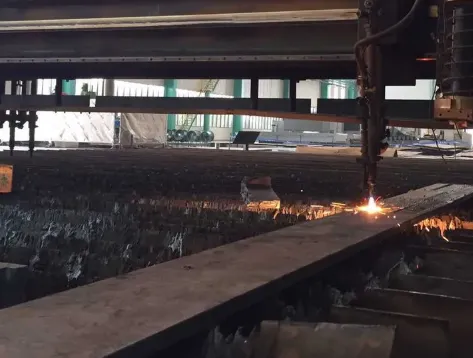
When evaluating "16Mo3 material properties," mechanical characteristics are often the focal point. These properties vary based on heat treatment and thickness, but standard values at room temperature include:
- Tensile Strength: 440-590 MPa – Indicates the material's ability to withstand pulling forces.
- Yield Strength: ≥275 MPa (for thicknesses up to 16mm) – The point at which permanent deformation begins.
- Elongation: ≥22% – Measures ductility, ensuring the steel can bend without fracturing.
- Impact Energy (Charpy V-Notch): ≥31 J at 20°C – Demonstrates toughness in impact scenarios.
- Hardness: Typically 130-170 HB – Suitable for machining and forming.
At elevated temperatures, 16Mo3 shines. For instance, at 400°C, its yield strength remains around 200 MPa, far superior to many carbon steels that weaken significantly above 300°C.
Heat Treatment and Weldability
16Mo3 pressure vessel plate is typically supplied in a normalized condition (heated to 890-950°C and air-cooled), which optimizes its microstructure for strength and toughness. Post-weld heat treatment (PWHT) is often recommended to relieve stresses and prevent cracking.
Weldability is another strong suit. With proper preheating (around 150-200°C) and low-hydrogen electrodes, 16Mo3 can be welded using methods like SMAW, GTAW, or SAW. Its low carbon equivalent (CE) of about 0.40 ensures minimal risk of hydrogen-induced cracking.
Corrosion and Oxidation Resistance
While not as corrosion-resistant as stainless steels, 16Mo3 hot-rolled plate offers good resistance to oxidation and scaling in steam and flue gas environments up to 550°C. The molybdenum content forms a protective layer, reducing sulfidation and carburization risks in petrochemical applications.
For enhanced protection, coatings or alloying adjustments can be considered, but in standard use, it's sufficient for non-aggressive media.
Applications of 16Mo3 in Industry

The "16Mo3 material properties" make it versatile across sectors:
- Boilers and Pressure Vessels: Core material for superheater tubes and steam boilers due to creep resistance.
- Power Plants: Used in headers, pipelines, and heat exchangers where temperatures exceed 400°C.
- Petrochemical Industry: Ideal for reactors and piping handling hot fluids.
- Oil & Gas: In refineries for equipment exposed to hydrogen sulfide at high temperatures.
Comparing 16Mo3 to Similar Materials
How does 16Mo3 stack up? Compared to P235GH (a non-alloy steel), 16Mo3 offers superior high-temperature performance but at a slightly higher cost. Versus 13CrMo4-5, it has less chromium for corrosion but better affordability for moderate environments.
If your project demands even higher temps, consider upgrading to 10CrMo9-10, but for most boiler applications, 16Mo3 strikes the best balance.
Conclusion: Why Choose 16Mo3 for Your Next Project?
In summary, the "16Mo3 material properties" – from its robust mechanical strength to exceptional heat resistance – position it as a reliable choice for high-stakes engineering. By incorporating this steel, you can enhance operational efficiency, reduce maintenance costs, and ensure safety in extreme conditions.
If you want to learn more about GNEE's products, you can send an email to alloy@gneesteelgroup.com. We are more than happy to assist you.
| Grades Of Pressure Vessel Plates Supplied By GNEE | |||||
| ASTM | ASTM A202/A202M | ASTM A202 Grade A | ASTM A202 Grade B | ||
| ASTM A203/A203M | ASTM A203 Grade A | ASTM A203 Grade B | ASTM A203 Grade D | ASTM A203 Grade E | |
| ASTM A203 Grade F | |||||
| ASTM A204/A204M | ASTM A204 Grade A | ASTM A204 Grade B | ASTM A204 Grade C | ||
| ASTM A285/A285M | ASTM A285 Grade A | ASTM A285 Grade B | ASTM A285 Grade C | ||
| ASTM A299/A299M | ASTM A299 Grade A | ASTM A299 Grade B | |||
| ASTM A302/A302M | ASTM A302 Grade A | ASTM A302 Grade B | ASTM A302 Grade C | ASTM A302 Grade D | |
| ASTM A387/A387M | ASTM A387 Grade 5 Class1 | ASTM A387 Grade 5 Class2 | ASTM A387 Grade 11 Class1 | ASTM A387 Grade 11 Class2 | |
| ASTM A387 Grade 12 Class1 | ASTM A387 Grade 12 Class2 | ASTM A387 Grade 22 Class1 | ASTM A387 Grade 22 Class2 | ||
| ASTM A515/A515M | ASTM A515 Grade 60 | ASTM A515 Grade 65 | ASTM A515 Grade 70 | ||
| ASTM A516/A516M | ASTM A516 Grade 55 | ASTM A516 Grade 60 | ASTM A516 Grade 65 | ASTM A516 Grade 70 | |
| ASTM A517/A517M | ASTM A517 Grade A | ASTM A517 Grade B | ASTM A517 Grade E | ASTM A517 Grade F | |
| ASTM A517 Grade P | ASTM A517 Grade J | ||||
| ASTM A533/A533M | ASTM A533 Grade A Class1 | ASTM A533 Grade B Class1 | ASTM A533 Grade C Class1 | ASTM A533 Grade D Class1 | |
| ASTM A533 Grade A Class2 | ASTM A533 Grade B Class2 | ASTM A533 Grade C Class2 | ASTM A533 Grade D Class2 | ||
| ASTM A533 Grade A Class3 | ASTM A533 Grade B Class3 | ASTM A533 Grade C Class3 | ASTM A533 Grade D Class3 | ||
| ASTM A537/A537M | ASTM A537 Class1 | ASTM A537 Class2 | ASTM A537 Class3 | ||
| ASTM A612/A612M | ASTM A612 | ||||
| ASTM A662/A662M | ASTM A662 Grade A | ASTM A662 Grade B | ASTM A662 Grade C | ||
| EN | EN10028-2 | EN10028-2 P235GH | EN10028-2 P265GH | EN10028-2 P295GH | EN10028-2 P355GH |
| EN10028-2 16MO3 | |||||
| EN10028-3 | EN10028-3 P275N | EN10028-3 P275NH | EN10028-3 P275NL1 | EN10028-3 P275NL2 | |
| EN10028-3 P355N | EN10028-3 P355NH | EN10028-3 P355NL1 | EN10028-3 P355NL2 | ||
| EN10028-3 P460N | EN10028-3 P460NH | EN10028-3 P460NL1 | EN10028-3 P460NL2 | ||
| EN10028-5 | EN10028-5 P355M | EN10028-5 P355ML1 | EN10028-5 P355ML2 | EN10028-5 P420M | |
| EN10028-5 P420ML1 | EN10028-5 P420ML2 | EN10028-5 P460M | EN10028-5 P460ML1 | ||
| EN10028-5 P460ML2 | |||||
| EN10028-6 | EN10028-6 P355Q | EN10028-6 P460Q | EN10028-6 P500Q | EN10028-6 P690Q | |
| EN10028-6 P355QH | EN10028-6 P460QH | EN10028-6 P500QH | EN10028-6 P690QH | ||
| EN10028-6 P355QL1 | EN10028-6 P460QL1 | EN10028-6 P500QL1 | EN10028-6 P690QL1 | ||
| EN10028-6 P355QL2 | EN10028-6 P460QL2 | EN10028-6 P500QL2 | EN10028-6 P690QL2 | ||
| JIS | JIS G3115 | JIS G3115 SPV235 | JIS G3115 SPV315 | JIS G3115 SPV355 | JIS G3115 SPV410 |
| JIS G3115 SPV450 | JIS G3115 SPV490 | ||||
| JIS G3103 | JIS G3103 SB410 | JIS G3103 SB450 | JIS G3103 SB480 | JIS G3103 SB450M | |
| JIS G3103 SB480M | |||||
| GB | GB713 | GB713 Q245R | GB713 Q345R | GB713 Q370R | GB713 12Cr1MoVR |
| GB713 12Cr2Mo1R | GB713 13MnNiMoR | GB713 14Cr1MoR | GB713 15CrMoR | ||
| GB713 18MnMoNbR | |||||
| GB3531 | GB3531 09MnNiDR | GB3531 15MnNiDR | GB3531 16MnDR | ||
| DIN | DIN 17155 | DIN 17155 HI | DIN 17155 HII | DIN 17155 10CrMo910 | DIN 17155 13CrMo44 |
| DIN 17155 15Mo3 | DIN 17155 17Mn4 | DIN 17155 19Mn6 | |||


