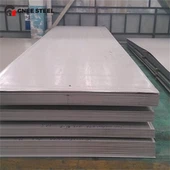

In the maritime industry, steel plates play a pivotal role in ensuring the structural integrity and safety of ships. Among the various grades of steel plates available, BV D420 marine steel plates stand out for their exceptional performance in harsh marine environments. These grades are specifically designed to meet the rigorous standards set by classification societies like Bureau Veritas (BV) for use in shipbuilding.
BV D420 extra High Strength Chemical Composition Tempering and Quenching | |||||||
Grade | The Element Max (%) | ||||||
C | Si | Mn | P | S | Al(min) | N | |
BV D420 | 0.20 | 0.55 | 1.70 | 0.030 | 0.030 | 0.015 | 0.020 |
Crack Sensitivity: Pcm = (C+Si/30+Mn/20+Cu/20+Ni/60+Cr/20+Mo/15+V/10+5B)%
Carbon Equivalent: Ceq = 【C+Mn/6+(Cr+Mo+V)/5+(Ni+Cu)/15】%
BV D420 extra High strength property in Tempering and Quenching | ||||||
Grade | Mechanical Property | Charpy V Impact Test | ||||
Yield | Tensile | Elongation | Degree | Energy 1 | Energy 2 | |
BV D420 | Min Mpa | Mpa | Min % | -20 | J | J |
420 | 530-680 | 18% | 28 | 42 | ||
Note: Energy 1 is transverse impact test, Energy 2 is longitudinal | ||||||
Impact testing is an essential part of the quality control process for these steel plates. This testing involves subjecting the steel to low-temperature impact loads to assess its toughness and resistance to cracking. BV D420 steel plates are designed to meet strict impact testing standards, ensuring their reliability in extreme conditions.
The primary applications of BV D420 steel plates are in the construction of ships and marine structures. These plates are widely used in the hulls of cargo ships, passenger vessels, and other types of watercraft. Their excellent corrosion resistance and high strength make them ideal for use in saltwater environments, where they are exposed to constant moisture and corrosive elements.