


The inner and outer sides of the flanges of H-shaped steel are parallel or close to parallel, and the flange ends are at right angles, hence the name parallel flange I-beam. The web thickness of H-shaped steel is smaller than that of ordinary I-beams with the same web height, and the flange width is larger than that of ordinary I-beams with the same web height, so it is also called wide-edge I-beam. Determined by its shape, the section modulus, moment of inertia and corresponding strength of H-shaped steel are significantly better than ordinary I-beams of the same unit weight.
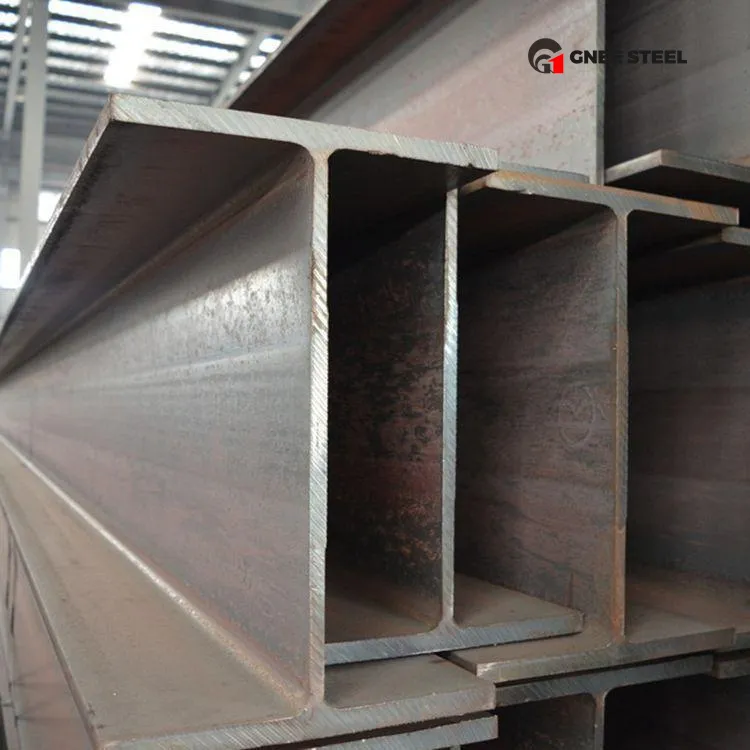
Classified by flange width. It is divided into wide flange H-shaped steel (HW), medium flange H-shaped steel (HM) and narrow flange H-shaped steel (HN). The flange width B of wide-flange and medium-flange H-shaped steel is greater than or equal to the web height H, while the flange width B of narrow-flange H-shaped steel is approximately equal to one-half of the web height H.
Classification by product use. Including H-shaped steel beams, H-shaped steel columns, H-shaped steel piles and extremely thick flange H-shaped steel beams. Narrow flange H-shaped steel is usually used as beam material, while wide-flange H-shaped steel is mostly used as column material.
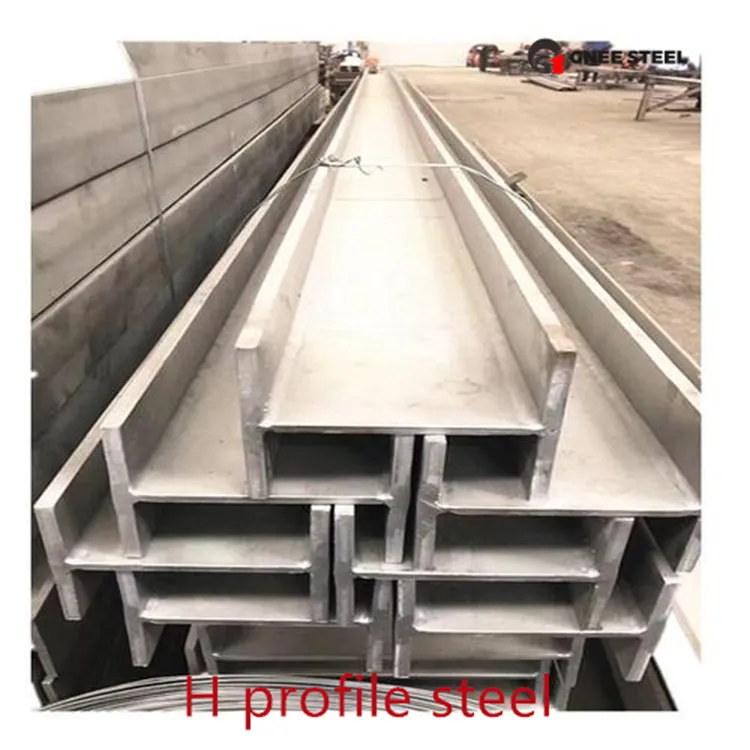
Classified by production method. It is divided into welded H-shaped steel and rolled H-shaped steel.
Classified by size. Divided into large, medium and small H-shaped steel. Usually, products with web height H above 700mm are called large sizes, those with web height H between 300 and 700mm are called medium sizes, and products with web height H less than 300mm are called small sizes.
In addition, parallel leg channel steel and parallel flange T-shaped steel are sometimes included in the scope of H-shaped steel.


