


Product Description
ASTM A612 pressure vessel steel plate is a killed carbon–manganese–silicon steel specified under ASTM A612/A612M. It is intended for the fabrication of welded pressure vessels and pressure-retaining equipment operating under moderate and lower temperature service conditions.

The killed steel practice ensures uniform internal quality and stable mechanical properties, making ASTM A612 suitable for applications requiring reliable strength, good toughness, and weldability.
Thickness Limitation
According to ASTM A612/A612M:
Maximum plate thickness: 1 in. [25 mm]
This thickness limitation ensures that the specified mechanical properties and toughness requirements can be consistently achieved through the full plate section.
Chemical Composition (%)
Heat Analysis / Product Analysis Limits
| Element | Heat Analysis (max / range) | Product Analysis (max / range) |
|---|---|---|
| Carbon (C) | ≤ 0.25 | ≤ 0.29 |
| Silicon (Si) | 0.15 – 0.50 | 0.13 – 0.55 |
| Manganese (Mn) | 1.00 – 1.50 | 0.92 – 1.62 |
| Phosphorus (P) | ≤ 0.025 | ≤ 0.030 |
| Sulfur (S) | ≤ 0.025 | ≤ 0.030 |
| Copper (Cu) | ≤ 0.035 | ≤ 0.038 |
Controlled chemical composition contributes to good weldability and resistance to brittle fracture.
Mechanical Properties
Mechanical Property Requirements
| Thickness | Yield Strength (min.) | Tensile Strength | Elongation (8 in.) | Elongation (2 in.) |
|---|---|---|---|---|
| ≤ 0.5 in. [12.5 mm] | 50 ksi [345 MPa] | 83 – 105 ksi [570 – 725 MPa] | 16% | 22% |
| 0.5 – 1.0 in. [12.5 – 25 mm] | 50 ksi [345 MPa] | 81 – 101 ksi [560 – 695 MPa] | 16% | 22% |
Material Characteristics
Good Strength and Ductility Balance for Pressure Service
ASTM A612 steel plates provide a minimum yield strength of 50 ksi (345 MPa) combined with tensile strength typically in the range of 81–105 ksi (560–725 MPa). This balance allows the material to withstand internal pressure while maintaining sufficient elongation (≥ 16% in 8 in. gauge length) to reduce the risk of brittle fracture.
Stable Toughness for Moderate and Lower Temperature Operation
ASTM A612 is designed for service at moderate and lower temperatures, commonly down to approximately –20°C, depending on design requirements. The killed steel practice and controlled chemical composition help ensure stable toughness performance in welded pressure vessels.
Low Sensitivity to Bending, Rolling, and Forming Processes
With controlled carbon content (C ≤ 0.25%) and balanced manganese–silicon levels, ASTM A612 exhibits low susceptibility to cracking during forming operations such as cold bending, rolling, and shaping, particularly within its specified thickness range of ≤ 25 mm.
Good Weldability Under Qualified Welding Procedures
ASTM A612 steel plates show good weldability due to moderate carbon equivalent and low impurity levels (P ≤ 0.025%, S ≤ 0.025%). Common welding methods such as SMAW, SAW, and GMAW can be applied when procedures comply with ASME BPVC requirements.
Reliable Performance in Welded Joints
The material maintains consistent mechanical properties across the plate and welded joints when proper welding and post-weld heat treatment practices are followed, supporting long-term service in pressure-retaining applications.
Typical Applications
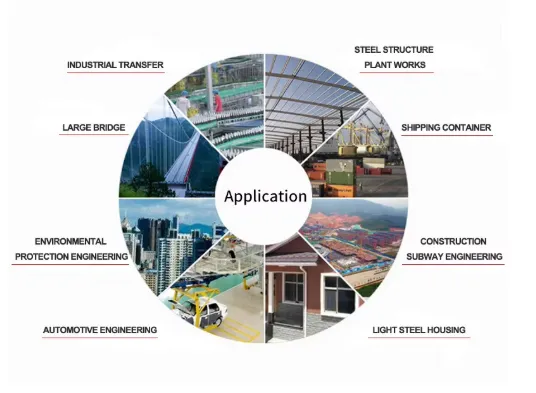
ASTM A612 pressure vessel steel plates are widely used in pressure-retaining equipment operating under moderate pressure and temperature conditions, including:
Welded Pressure Vessels
Typical design pressure: 1.6 – 10 MPa
Typical service temperature: –20°C to +350°C
Applications: separators, reactors, absorbers, heat exchangers
Boilers and Pressure-Retaining Components
Operating temperature: up to approximately 350°C
Typical plate thickness: 6 – 25 mm
Service condition: internal pressure combined with thermal stress
Chemical and Petrochemical Processing Equipment
Service media: hydrocarbons, chemical process fluids, gases
Operating conditions: pressure with cyclic thermal loading
Key requirement: resistance to brittle fracture at welded joints
Storage Tanks for Pressurized Gases and Liquids
Typical working pressure: 1.0 – 8.0 MPa
Temperature range: –20°C to +300°C
Applications: LPG tanks, industrial gas vessels
Power Generation and Energy-Related Pressure Equipment
Applications: auxiliary boilers, pressure vessels, energy storage systems
Design codes: ASME Boiler and Pressure Vessel Code
Key advantage: stable long-term mechanical performance
ASTM A612 steel plates are commonly used in pressure vessels designed in accordance with the ASME Boiler and Pressure Vessel Code. Final allowable stress, thickness, and service limits must be determined by design calculations and applicable codes.
Q1: What type of steel is ASTM A612?
A:
ASTM A612 is a killed carbon–manganese–silicon pressure vessel quality (PVQ) steel plate. It is specifically designed for welded pressure vessels operating at moderate and lower temperatures, where good strength and notch toughness are required.
Compared with general structural steels, A612 places greater emphasis on pressure resistance, weld joint reliability, and fracture toughness.
Q2: What is the main difference between ASTM A612 and ASTM A516?
A:
Both A612 and A516 are pressure vessel steels, but they are intended for different service priorities.
| Item | ASTM A612 | ASTM A516 |
|---|---|---|
| Steel Type | C–Mn–Si PVQ steel | Fine-grain PVQ steel |
| Thickness Limit | ≤ 25 mm | Up to ~200 mm |
| Temperature Focus | Moderate & lower temperatures | Moderate & low temperatures |
| Toughness Control | Notch toughness emphasized | Charpy impact emphasized |
| Typical Use | Medium-pressure vessels | Boilers & thick pressure vessels |
Summary:
A612 is commonly selected for medium thickness, moderate pressure vessels
A516 is preferred when thicker plates or mandatory impact testing are required
Q3: How does ASTM A612 compare with EN P275 / P355 series?
A:
| Item | ASTM A612 | EN P275 / P355 |
|---|---|---|
| Standard System | ASTM / ASME | EN 10028 |
| Yield Strength | 295–355 MPa | 275 / 355 MPa |
| Thickness Limit | ≤ 25 mm | Wider thickness range |
| Delivery Condition | AR / N / SR | Usually normalized |
| Application Focus | Pressure vessels | Pressure vessels & boilers |
ASTM A612 is more commonly used in ASME-code pressure vessels, while P275/P355 grades are preferred in European-standard equipment.
Q4: What are the differences between A612 Class 1, Class 2, and Class 3?
A:
The three classes mainly differ in strength level and notch toughness.
| Class | Min Yield Strength | Toughness Level | Typical Selection |
|---|---|---|---|
| Class 1 | ≥ 345 MPa | Good | General pressure vessels |
| Class 2 | ≥ 390 MPa | Improved | Higher pressure designs |
| Class 3 | ≥ 450 MPa | Highest | High safety margin vessels |
Higher class selection allows for thinner wall design or higher design pressure, subject to code calculations.
Q5: Is ASTM A612 suitable for low-temperature service?
A:
ASTM A612 is suitable for moderate and lower temperature service, typically down to around –20°C, depending on design requirements and testing conditions.
For lower temperatures (below –20°C) or mandatory impact energy requirements, grades such as A516 with specified Charpy impact testing may be more appropriate.
| Other steel plate by GNEE | ||||
| Name | Material | Specification (mm) | Tons | Remark |
| Clad steel plate | P265GH+410,S355JR+410,A516Gr70+316, A537CL1+304L,Q235B+304L,Q345B+304, A516Gr70(NACE)+410,A537CL1+904L, A537CL1+316L,A516Gr70+304L,A537CL1+304 ,A516Gr70+410,A516Gr70+904L |
2-300mm(Based plate),1-50mm(Composited plate) | / | UT, AR, TMCP.Normalized, Quenched and Tempered,Z Direction Test, Charpy V-Notch impact TestThe Third Party Test , Coated or Shot Blasting and Painting. |
| Low Alloy | Q345A, Q345B, Q345C, Q345D, Q345E, Q390, Q420, Q460C, ST52-3, S355J2+N, SS400, SA302GrC, S275NL, 35CrMo | 6 - 350 | 5788.56 | Normalizing, tempered ,controlled rolling, hot rolling , Hot rolling,1st inspection, 2nd inspection, 3rd inspection |
| Pressure Vessel Plate | Q245R, Q345R, Q370R, 16MnDR, 09MnNiDR, 15CrMoR, 14Cr1MoR, 12Cr2Mo1R, SA516Gr60, SA516Gr70, SA516Gr485, SA285, SA387Gr11, SA387Gr12, SA387Gr22, P265,P295,P355GH,Q245R(R-HIC),Q345R(R-HIC) | 3 - 300 | 8650 | Normalizing, tempered ,controlled rolling, hot rolling , Hot rolling,1st inspection, 2nd inspection, 3rd inspection |
| High-Strength Plate | WH785D/E,Q960D/E, Q890D/E,WH60D/E,WH70B,Q550D,Q590D,Q690D/E | 8 - 120 | 3086.352 | Quenched and tempered |
| Wear-Resistant Plate | NM360, NM400, NM450, NM500 | 6 - 150 | 3866.297 | Quenched and tempered |
| Bridge Plate | Q235qC, Q345qC, Q370qC, Q420qC, Q345qDNH, Q370qDNH, A709 - 50F - 2, A709 - 50T - 2 | 8 - 200 | ||


