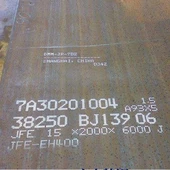
DNV D460 is an extra-high-strength structural steel plate certified by DNV (Det Norske Veritas) for marine and offshore applications . The "D" designation signifies that the material's impact toughness is tested and guaranteed at -20°C . It has a minimum yield strength of 460 MPa (67 ksi) and tensile strength ranging from 570 to 720 MPa (83-105 ksi), with minimum elongation of 17% . Impact energy requirements are minimum 46J (longitudinal) or 31J (transverse) at -20°C . The chemical composition is strictly controlled with carbon ≤0.20% and manganese ≤1.70% . This grade is typically supplied in thermomechanical controlled processed (TMCP) or normalized conditions . It is widely used for hull construction, offshore platforms, and marine structures operating in cold environments.
DNV D620 is an ultra-high-strength structural steel plate also certified by DNV with impact toughness tested at -20°C . The "620" denotes a minimum yield strength of 620 MPa . It has a tensile strength ranging from 720 to 890 MPa and minimum elongation of 15% (longitudinal) . Impact energy requirements are minimum 62J (longitudinal) or 41J (transverse) at -20°C . The chemical composition features carbon ≤0.20%, manganese ≤1.70%, with microalloying elements including Nb, V, Ti, Ni, Cr, and Mo for enhanced properties . This grade requires advanced processing and is typically supplied in quenched and tempered (QT) or TMCP conditions . It is designed for demanding structural components in shipbuilding, ultra-deepwater offshore platforms, and marine structures requiring maximum strength-to-weight ratio.
Both DNV D460 and DNV D620 are DNV-certified high-strength marine steels with impact toughness tested at -20°C, ensuring reliable performance in cold marine environments . Their primary difference lies in strength level: D460 offers a minimum yield strength of 460 MPa with tensile strength of 570-720 MPa, suitable for general high-strength hull construction and offshore structures , while D620 provides a substantially higher minimum yield strength of 620 MPa with tensile strength reaching 720-890 MPa, designed for the most demanding load-bearing applications requiring maximum strength-to-weight ratio . Both grades feature controlled chemical composition with carbon ≤0.20% and manganese ≤1.70% , and require advanced processing like TMCP or QT to achieve their mechanical properties while maintaining good weldability for critical marine service.
Chemical Composition
|
DNV D460 extra high Strength Chemical Composition |
|||||||
|
Grade |
The Element Max (%) |
||||||
|
C |
Si |
Mn |
P |
S |
Al |
N |
|
|
DNV D460 |
0.20 |
0.10-0.55 |
1.7 |
0.030 |
0.030 |
0.015-0.08 |
0.020 |
|
Nb |
V |
Ti |
Cu |
B |
Ni |
Mo |
|
|
0.02-0.05 |
0.04-0.10 |
0.02 |
|
0.005 |
|
|
|
|
DNV D620 extra high Strength Chemical Composition |
|||||||
|
Grade |
The Element Max (%) |
||||||
|
C |
Si |
Mn |
P |
S |
Al |
N |
|
|
DNV D620 |
0.20 |
0.10-0.55 |
1.7 |
0.030 |
0.030 |
0.015-0.08 |
0.020 |
|
Nb |
V |
Ti |
Cu |
B |
Ni |
Mo |
|
|
0.02-0.05 |
0.04-0.10 |
0.02 |
|
0.005 |
|
|
|
Mechanical Property
|
DNV D460 extra high general strength property |
|||||||
|
Grade |
|
Mechanical Property |
Charpy V Impact Test |
||||
|
Thickness |
Yield |
Tensile |
Elongation |
Degree |
Energy 1 |
Energy 2 |
|
|
DNV D460 |
mm |
Min Mpa |
Mpa |
Min % |
-20 |
J |
J |
|
t≤50 |
460 |
570-720 |
17% |
31 |
46 |
||
|
50<t≤70 |
460 |
570-720 |
17% |
31 |
46 |
||
|
70<t≤150 |
460 |
570-720 |
17% |
31 |
46 |
||
|
Note: Energy 1 is transverse impact test, Energy 2 is longitudinal |
|||||||
|
DNV D620 extra high general strength property |
|||||||
|
Grade |
|
Mechanical Property |
Charpy V Impact Test |
||||
|
Thickness |
Yield |
Tensile |
Elongation |
Degree |
Energy 1 |
Energy 2 |
|
|
DNV D620 |
mm |
Min Mpa |
Mpa |
Min % |
-20 |
J |
J |
|
t≤50 |
620 |
720-890 |
15% |
41 |
62 |
||
|
50<t≤70 |
620 |
720-890 |
15% |
41 |
62 |
||
|
70<t≤150 |
620 |
720-890 |
15% |
41 |
62 |
||
|
Note: Energy 1 is transverse impact test, Energy 2 is longitudinal |
|||||||