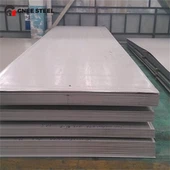
S460N and S460NL: Normalized 460 MPa Structural Plate
S460N and S460NL are high strength structural steel plates supplied under EN 10025-3, the European standard for hot rolled structural steels in the normalized or normalized rolled delivery condition. Both grades guarantee a minimum yield strength of 460 MPa, a fine grain microstructure, and consistent through thickness properties in heavy plate up to 150 mm.
The designation explains the relationship between the grades. S stands for structural steel, 460 is the minimum yield strength in MPa, N indicates normalizing or normalized rolling, and the trailing L adds a guaranteed impact energy at a lower test temperature. Because the first three elements are identical, the two plates are interchangeable in moderate climates and separate only where sub zero service governs the design.
Production uses a fine grain practice with a controlled aluminum addition that fixes nitrogen and refines the grain size, keeping the ductile to brittle transition temperature low. Normalizing at approximately 900 °C followed by air cooling produces a uniform ferrite and pearlite structure with a grain size of ASTM 6 or finer, so the 460 MPa yield strength is maintained through the full thickness of the plate.
Chemical Composition Comparison
The base limits are identical for the two grades. The L class applies tighter restrictions to phosphorus and sulfur, the elements that most strongly influence low temperature toughness.
| Element | S460N max, % | S460NL max, % | Effect on behaviour |
|---|---|---|---|
| Carbon (C) | 0.20 | 0.20 | Raises strength; kept low for weldability |
| Silicon (Si) | 0.60 | 0.60 | Deoxidation and solid solution strengthening |
| Manganese (Mn) | 1.00-1.70 | 1.00-1.70 | Balances strength against toughness |
| Phosphorus (P) | 0.030 | 0.025 | Segregation control; lower value improves toughness |
| Sulfur (S) | 0.025 | 0.020 | Controls inclusions and lamellar tearing risk |
| Niobium (Nb) | 0.05 | 0.05 | Grain refinement during controlled rolling |
| Vanadium (V) | 0.20 | 0.20 | Precipitation strengthening |
Mechanical Properties at a Glance
| Property | S460N | S460NL |
|---|---|---|
| Minimum yield strength, t up to 16 mm | 460 MPa | 460 MPa |
| Tensile strength | 540-720 MPa | 540-720 MPa |
| Minimum elongation | 17 % | 17 % |
| Charpy V-notch impact, minimum | 27 J at -20 °C | 27 J at -50 °C |
| Typical hardness | 170-210 HBW | 170-210 HBW |
| Delivery condition | Normalized or normalized rolled | Normalized or normalized rolled |
Low Temperature Toughness and Fabrication
Impact testing is the single point of separation between the grades. S460N is qualified at -20 °C, which covers temperate regions, most inland sites, and sheltered or indoor structures. S460NL is qualified at -50 °C and therefore suits Arctic installations, northern offshore platforms, and structures whose metal temperature can fall far below ambient.
Fabrication practice is similar for both. Welding follows a qualified procedure with preheating in the range 100-150 °C for sections thicker than 20 mm, and post weld heat treatment is optional; where specified it is carried out at 550-650 °C. Solid wire to ER70S-6 for gas metal arc welding, and EH14 wire with EM12K flux for submerged arc welding, produce joints of matched strength. Because S460NL carries fewer phosphorus and sulfur rich inclusions, it shows lower susceptibility to weld metal cracking and better heat affected zone toughness.
Cold forming is practical with generous bend radii; hot forming needs care to avoid over tempering the normalized structure.
Machining follows normal practice for a 460 MPa steel, using carbide tooling with positive rake angles.
Thermal cutting is acceptable for edge preparation; cut edges thicker than 40 mm benefit from a light grinding pass before welding.
Applications and Grade Selection
S460N: bridge girders, crane booms, building frameworks, and general load bearing structures in moderate climates.
S460NL: offshore platforms, wind turbine towers, cold region bridges, and storage structures for northern or Arctic projects.
Selection rule: use S460N where the minimum design metal temperature stays above -20 °C, and step up to S460NL when the design temperature reaches -50 °C.
Frequently Asked Questions
Q: Is S460NL a stronger steel than S460N?
No. Both grades have the same minimum yield strength of 460 MPa and the same 540-720 MPa tensile range. Only the impact test temperature differs.
Q: Can S460N and S460NL be welded to each other?
Yes. Matching consumables, preheat and interpass conditions are the same, so a qualified procedure for one grade normally covers the other.
Q: What does the letter L mean in S460NL?
L marks a low temperature impact requirement: the plate must still absorb the specified minimum Charpy energy when tested at -50 °C instead of -20 °C.
Q: Are both grades supplied in the normalized condition?
Yes. EN 10025-3 allows normalized or normalized rolled delivery for both grades, and the mechanical values above apply to that condition.
Q: Which grade suits a bridge in a cold inland region?
Where the design metal temperature reaches -50 °C, S460NL is the safer choice; for warmer inland sites S460N is sufficient and more economical.
Q: Does the yield strength fall in thicker plate?
The 460 MPa minimum applies up to 16 mm. Above that EN 10025-3 permits a stepped reduction with thickness, so each thickness range should be checked against the standard table.