



 ASTM A387 Grade 11 Class 1 is a nominal 1.25% Cr – 0.5% Mo chromium-molybdenum alloy steel plate for pressure vessels. Specifically engineered for boilers and pressure vessels operating in high-temperature environments, it delivers superior high-temperature strength retention and creep resistance, making it a classic, industry-standard grade worldwide.
This grade is dual-certified under both ASTM A387/A387M and ASME SA-387/SA-387M (ASME BPVC Section II, Part A), with general requirements complying with ASTM A20/A20M and designated with UNS number K11789. Consequently, a single plate can fulfill both ASTM procurement requirements and ASME Code-stamped boiler and pressure vessel fabrication needs.
GNEE Steel has long specialized in the export of specialty steels, with core offerings including pressure vessel plates, boiler plates, and Cr-Mo alloy steel plates for heavy engineering applications. We serve international EPC contractors, boiler and pressure vessel manufacturers, and steel distributors with verifiable quality data and end-to-end export fulfillment. Every batch is supplied with heat-traceable Mill Test Certificates (MTCs) and third-party inspection reports, supported by a full-scope supply chain covering material selection, processing, and ocean freight logistics.
ASTM A387 Gr.11 Class 1 vs. Class 2: Selection Guide
Both classes share identical chemical compositions; the difference lies in their supply condition (heat treatment) and mechanical strength levels.
How to Select?
By Design Stress
Allowable design stress at elevated temperatures is dictated by yield and tensile strength limits. If the design stress falls within the Class 1 allowable limit, Class 1 provides a more economical solution. If higher allowable stress is required to achieve weight reduction via thinner walls, Class 2 is recommended.
By Thickness & Process Requirements
Heavy-gage plates exhibit limited hardenability during Normalizing & Tempering (N&T). For extra-heavy thicknesses, Class 1-which permits supply in the Annealed condition-is preferred. Class 1 is also the safer choice when high weldability and cold-forming allowances are required.
By Stock Availability & Lead Time
Because Class 1 and Class 2 share the same chemistry, mills can convert between classes via tailored heat treatment (where code-compliant). You can verify stock availability and heat-treatment conversion options directly with our sales team during inquiry.
Uncertain whether to select Class 1 or Class 2?
Send us your design temperature, design pressure, working medium, and required plate thickness. The GNEE technical team will provide complimentary material selection guidance and grade-equivalent analysis. Free Consultation on Material Selection
ASTM A387 Gr.11 Class1 Alloy Steel Plate Key Performance Advantages
High-Temperature Strength Retention
The Cr-Mo alloy system maintains significant tensile and yield strength within the typical operating range of 400°C to 550°C, vastly outperforming carbon and C-Mn steels of equivalent thickness. It serves as the primary material choice for high-temperature pressure-retaining components.
Creep Resistance
Molybdenum (Mo) imparts excellent resistance to high-temperature creep, making the material ideal for equipment requiring long-term dimensional stability under elevated temperatures and pressures (e.g., steam drums, headers, high-temperature reactors).
Sour Service Corrosion Resistance
Demonstrates field-proven corrosion performance in sour gas (H₂S) and high-temperature sulfide environments, widely utilized in downstream refining and petrochemical processing equipment.
Excellent Weldability
Features a mature chemistry with a forgiving welding window. Combined with proper preheating and Post-Weld Heat Treatment (PWHT at approx. 690°C ± 14°C), reliable welded joints are consistently achievable using standard, readily available filler metals.
Uniform & Controlled Properties
Supplied in Normalized & Tempered (N&T) or Quenched & Tempered (Q&T) conditions to ensure uniform through-thickness mechanical properties. Thickness tolerances, flatness, and Ultrasonic Testing (UT) strictly comply with ASTM A20/A20M, ensuring full batch traceability.
Clear Portfolio Positioning
Within the ASTM A387 series (Gr. 5, 9, 11, 12, 22, 91), Grade 11 represents a highly cost-effective solution for intermediate temperature ranges, bridging performance with higher Cr-Mo grades while offering better fabricability and cost efficiency.
ASTM A387 Gr.11 Class1 Equivalent Grade Comparison Table
| Standard / Specification | Grade / Designation |
| ASTM A387 / A387M | Gr. 11 Cl. 1 / Cl. 2 |
| ASME SA-387 / SA-387M | Gr. 11 Cl. 1 / Cl. 2 |
| JIS G3118 | SCMV3 |
| EN 10028-2 |
13CrMo4-5 (1.7335) /13CrMoSi5-5 |
| BS 1501 | 621 (621B) |
ASTM A387 Gr.11 Class1 1.25Cr-0.5Mo Steel Plate chemical composition
| Element | Composition Range / Maximum (%) |
| Carbon | 0.05–0.17 |
| Manganese | 0.40–0.65 |
| Phosphorus | ≤ 0.025 |
| Sulfur | ≤ 0.025 |
| Silicon | 0.50–0.80 |
| Chromium | 1.00–1.50 |
| Molybdenum | 0.45–0.65 |
ASTM A387 Gr.11 Class1 1.25Cr-0.5Mo Steel Plate mechanical property
| Mechanical Property / Parameter | Class 1 | Class 2 |
| Tensile Strength | 415–585 MPa (60–85 ksi) | 515–690 MPa (75–100 ksi) |
| Yield Strength, min. | 240 MPa (35 ksi) | 310 MPa (45 ksi) |
| Elongation in 2 in. (50 mm), min. | 22% | 22% |
| Supply Condition / Heat Treatment | Annealed / Normalized & Tempered (N&T) / Quenched & Tempered (Q&T) | Normalized & Tempered (N&T) / Quenched & Tempered (Q&T) |
| Minimum Tempering Temperature | ≥620°C (1150°F), applicable to N&T or Q&T conditions | ≥620°C (1150°F) |
ASTM A387 Gr.11 Class1 Steel Plate thermal property
| Property | Value | Comment |
|---|---|---|
|
Coefficient of thermal expansion |
9e-06 - 1.3e-05 1/K |
Typical for Nickel Molybdenum Steel |
|
Melting point |
1382 - 1529 °C |
Typical for Nickel Molybdenum Steel |
|
Specific heat capacity |
335 - 481 J/(kg·K) |
Typical for Nickel Molybdenum Steel |
|
Thermal conductivity |
44 W/(m·K) |
Typical for Nickel Molybdenum Steel |
ASTM A387 Gr.11 Cl.1 Chromium-Molybdenum Alloy Pressure Vessel Plate Specification
| Parameter | Specification & Description |
| Product Name | ASTM A387 Gr.11 Cl.1 / ASME SA387 Gr.11 Cl.1 Chromium-Molybdenum Alloy Pressure Vessel Plate |
| Grade / Standards | ASTM A387/A387M, ASME SA-387/SA-387M; General Requirements: ASTM A20/A20M; UNS K11789 |
| Thickness |
6–150 mm (Standard: 8–100 mm; custom mill rolling available for non-standard thicknesses upon agreement) |
| Width | 1500–4000 mm |
| Length | 3000–15000 mm (Custom cut-to-length available) |
| Surface & Delivery Condition | As-Rolled / Annealed / Normalized / Normalized & Tempered (N&T) / Quenched & Tempered (Q&T). Surface finishes options: Shot blasting, sand blasting, or pickling (per contract agreement). |
| Processing Services | Oxy-fuel / Plasma / Laser cutting, beveling, drilling, precision cut-to-length, leveling/flattening, shot blasting, shop priming, Ultrasonic Testing (UT) / Magnetic Particle Testing (MT), and test coupon preparation. |
| Export Packaging | Seaworthy export packaging featuring heavy-duty wooden pallets, waterproof kraft paper and moisture-proof film wrapping, high-tensile steel strapping, and corner edge protectors. Suitable for containerized (FCL/LCL) and breakbulk ocean shipment. Customized packaging and shipping marks are available upon request. |
ASTM A387 Gr.11 Class1 Plate Metallurgy & Heat Treatment
Typical Process Route
EAF/BOF Melting → LF Refining → VD Vacuum Degassing → Continuous Casting / Ingot Casting → Slab Reheating & Rolling → Heat Treatment → Mechanical & Chemical Testing (Chemical Analysis, Tensile, Charpy Impact, UT) → Processing & Re-inspection → Final Warehouse Entry.

Heat Treatment Specifications (Key Parameters):
- Class 1: Supplied in Annealed, Normalized & Tempered (N&T), or Quenched & Tempered (Q&T) conditions.
- Class 2: Mandatory Normalized & Tempered (N&T) or Quenched & Tempered (Q&T) conditions.
- Minimum Tempering Temperature: 620°C (1150°F). Tempering following normalizing or quenching is mandatory to stabilize the microstructure and restore toughness.
- Post-Weld Heat Treatment (PWHT): Typically 690°C ± 14°C (aligned with standard ASME PWHT ranges), to be executed per design code and WPS requirements.
Engineering Notice: Designed specifically for high-temperature service, this grade exhibits limited low-temperature toughness and is not recommended for cryogenic or low-temperature applications. Welding requires preheating per WPS (typical preheat for 1.25Cr-0.5Mo is 150°C–250°C depending on plate thickness and governing codes), strict interpass temperature control, and code-compliant PWHT.
ASTM A387 Gr.11 Class1 Plate Typical Applications
 Boilers: Steam drums, headers, and pressure-retaining components in power plant and industrial boilers.
Pressure Vessels: High-temperature reactors, separators, column/tower shells, and heads, as well as large-scale vessels requiring wall thickness optimization for weight reduction.
Refining & Petrochemical: Shells, tube sheets, and high-temperature piping for crude distillation units (CDU/VDU), fluid catalytic cracking (FCC), delayed coking, and sulfur recovery units (SRU); high-temperature equipment in sour gas service.
Power Generation: Steam drums, headers, feedwater heater shells, and tube sheets for power boilers.
Heat Exchangers: Shells, tube sheets, and heavy-wall flanges for high-temperature shell-and-tube heat exchangers.
Process Plants: Reliable material choice for intermediate-temperature (typically 400°C–550°C), high-pressure process piping and reactor shells.
Why Choose GNEE Steel?
Quality & Inspection
Supports third-party inspection (TPI) by SGS, BV, TÜV, Intertek, or client on-site inspection. Supplementary testing including Ultrasonic Testing (UT), Magnetic Particle Testing (MT), Charpy V-Notch Impact, and Bend Tests are available upon project specification.
Value-Added Processing
Custom cutting, beveling, drilling, cut-to-length, leveling, shot blasting, and shop priming. Delivered ready for assembly according to fabrication drawings to minimize secondary processing on the client's end.
Export Packaging
Standard export packaging utilizing wooden pallets, waterproof moisture barriers, and heavy-duty steel strapping. Suitable for containerized (FCL/LCL) and breakbulk shipment, with customized shipping marks per destination port requirements.


Inquire today to receive: Ex-factory Quote (Within 24 Hours) · Free Cutting Samples · Drawing Review Support · Tiered Pricing for Volume Orders
Send us your material specification schedule-GNEE delivers verifiable quality with reliable engineering data. Get a Quote
GNEE group team photo

GNEE group customer visit


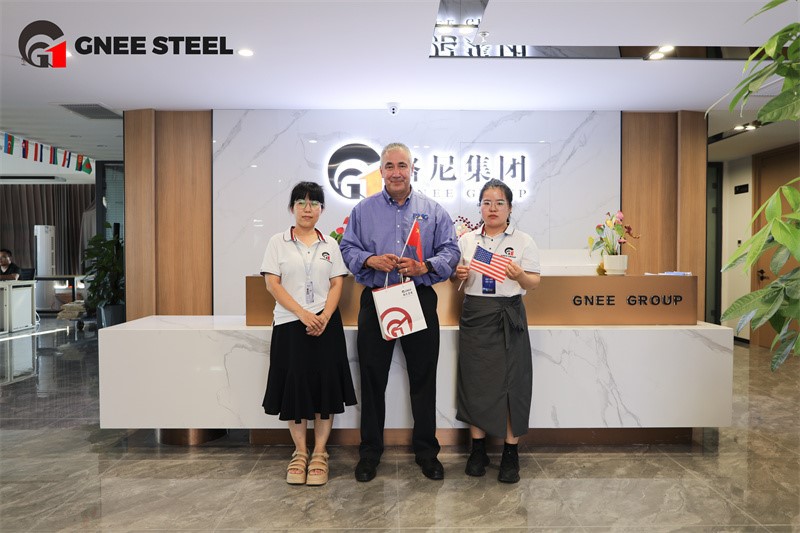


GNEE Group steel exhibition


We guarantee the quality and quantity of A387 Grade 11 Class1 Cr.Mo Alloy Steel Plate. If you want to know more information, please contact us!
Hot Tags: ASTM A387 Gr.11 Class1 1.25Cr-0.5Mo Alloy Steel Plate for Boilers & Vessels, China ASTM A387 Gr.11 Class1 1.25Cr-0.5Mo Alloy Steel Plate for Boilers & Vessels manufacturers, suppliers, factory, A515 Pressure Vessel Steel Plate, ASTM ASME Pressure Vessel Steel, SA516 Steel Boiler Plate, A537 Steel Plate, plate astm a516 gr 70, pressure vessel steel grades


