


1.Chemical Composition
EN10025 S275J0, S275J2 and S275JR chemical composition based on ladle analysis is given in the following table.
| Chemical Composition (ladle analysis), %, ≤ | ||||||||||
| Country (Region) | Standard | Steel Grade (Steel number) | C | Mn | P | S | N | Cu | Thickness (d) (mm) | Method of deoxidation |
| European Union | EN 10025-2 | S275JR (1.0044) | 0.21 | 1.50 | 0.035 | 0.035 | 0.012 | 0.55 | ≤ 40 | Rimmed steel not allowed |
| 0.22 | > 40 | |||||||||
| S275J0 (1.0143) | 0.18 | 1.50 | 0.030 | 0.030 | 0.012 | 0.55 | ≤ 150 | Rimmed steel not allowed | ||
| 0.20 | > 150 | |||||||||
| S275J2 (1.0145) | 0.18 | 1.50 | 0.025 | 0.025 | – | 0.55 | ≤ 150 | Fully Killed | ||
| 0.20 | > 150 | |||||||||
Datasheet 2, chemical composition based on product analysis.
| Chemical Composition (product analysis), %, ≤ | ||||||||||
| Country (Region) | Standard | Steel Grade (Steel number) | C | Mn | P | S | N | Cu | Thickness (d) (mm) | Method of deoxidation |
| European Union | EN10025-2 | S275JR (1.0044) | 0.24 | 1.60 | 0.045 | 0.045 | 0.014 | 0.60 | ≤ 40 | Rimmed steel not allowed |
| 0.25 | > 40 | |||||||||
| S275Jo (1.0143) | 0.21 | 1.60 | 0.040 | 0.040 | 0.014 | 0.60 | ≤ 150 | Rimmed steel not allowed | ||
| 0.22 | > 150 | |||||||||
| S275J2 (1.0145) | 0.21 | 1.60 | 0.035 | 0.035 | – | 0.60 | ≤ 150 | Fully Killed | ||
| 0.22 | > 150 | |||||||||
S275 Steel Properties
Physical Properties
S275 mild steel density: 7.85 g/cm3
Melting point: 1420-1460 °C (2590-2660 °F)
Mechanical Properties
S275 steel mechanical properties such as yield strength, tensile strength, elongation and impact resistance are given in datasheet below.
2.Yield Strength
Grade S275
| S275 Yield Strength (≥ MPa); Dia. (d) mm | |||||||||
| Steel | Steel Grade (Steel Number) | d≤16 | 16< d ≤40 | 40< d ≤63 | 63< d ≤80 | 80< d ≤100 | 100< d ≤150 | 150< d ≤200 | 200< d ≤250 |
| S275 | S275JR (1.0044) | 275 | 265 | 255 | 245 | 235 | 225 | 215 | 205 |
| S275J0 (1.0143) | |||||||||
| S275J2 (1.0145) | |||||||||
3.Tensile Strength
EN 10025 S275
| S275 Tensile Strength (≥ MPa) | |||||
| Steel | Steel Grade | d<3 | 3 ≤ d ≤ 100 | 100 < d ≤ 150 | 150 < d ≤ 250 |
| S275 | S275JR (1.0044) | 430-580 | 410-560 | 400-540 | 380-540 |
| S275J0 (1.0143) | |||||
| S275J2 (1.0145) | |||||
Note: 1MPa = 1N/mm2

4.Elongation
S275 material Datasheet – 5
| Elongation (≥%); Thickness (d) mm | |||||||||||
| Steel | Steel Grade | d≤1 | 1< d ≤1.5 | 1.5 < d ≤2 | 2 < d ≤ 2.5 | 2.5 < d ≤ 3 | 3 ≤d ≤40 | 40< d ≤63 | 63 < d ≤100 | 100 < d ≤ 150 | 150 < d ≤ 250 |
| S275 | S275JR | 15 | 16 | 17 | 18 | 19 | 23 | 22 | 21 | 19 | 18 |
| S275J0 (S275JO) | |||||||||||
| S275J2 | 13 | 14 | 15 | 16 | 17 | 21 | 20 | 19 | 19 | 18 | |
5. Delivery Status of S275JR Steel Plate
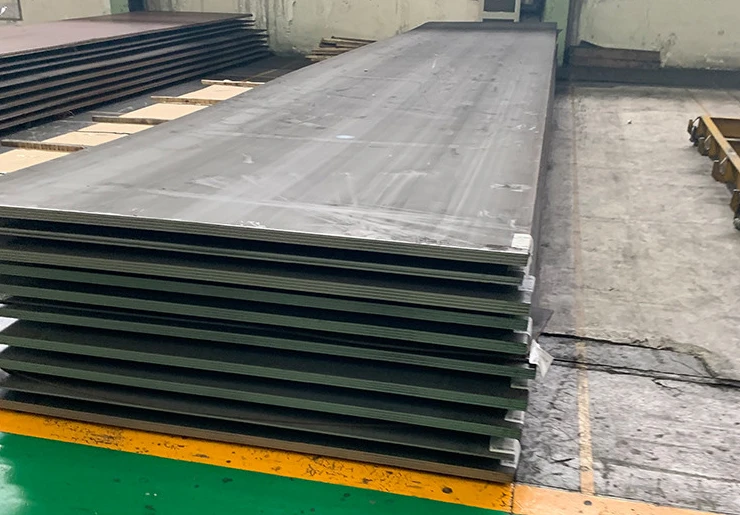
S275JR steel plate is delivered in the controlled rolled state by default. If the grade is displayed as "S275JR+N," the delivery status is normalized rolled or normalized.
Thickness testing options for S275JR steel plate include: 1st, 2nd, and 3rd test.
Thickness extension options for S275JR steel plate include: Z15, Z25, and Z35.
6.What is the role of flaw detection in steel plate?
Steel plate flaw detection is an important nondestructive testing method that can inspect the surface and interior of steel plates for cracks, inclusions, bubbles, and defects, ensuring their quality and safety. This flaw detection allows for comprehensive and detailed inspection and evaluation of steel plates, preventing safety incidents and operational issues. Therefore, flaw detection is an essential step in both industrial production and steel plate sales.
7.What is the role of Z-axis extension in steel plates?
Currently, Z-axis steel is widely used in steel structures and bridge engineering, not only reducing the weight of steel structures and improving safety, but also reducing costs. In most cases, the steel exhibits sufficient lamellar tear resistance, or even if lamellar tearing occurs, it will not affect the safety of the structure. When choosing between Z-axis plate and conventional plate, the key considerations are to meet application requirements while minimizing costs and improving manufacturing process feasibility. For welded connections in critical structural parts, tensile stresses in the plate thickness direction should be avoided when the plate thickness exceeds 15 mm. Lamellar tear-resistant steel should only be used as a last resort.


