

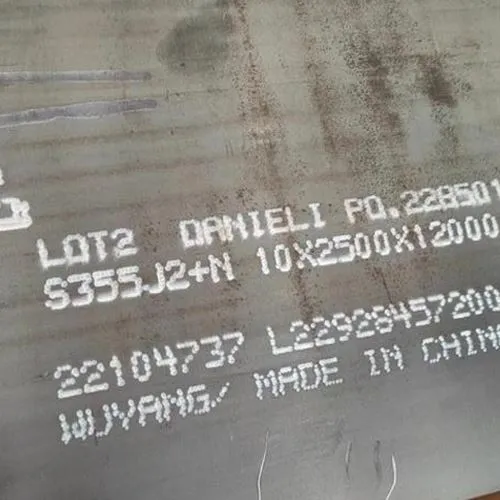
S355J2+N is a high-strength, low-alloy (HSLA) structural steel known for its excellent weldability and superior low-temperature impact toughness (tested at -20°C). It is widely utilized in structural engineering, steel frameworks, bridges, storage tanks, heavy-duty vehicles, shipbuilding, and general structural components.
The "+N" suffix indicates a normalized delivery condition, which generally corresponds to Q345D under the Chinese GB/T 1591 standard or St52-3 under the German DIN 17100 standard.
Grade Breakdown: S355J2+N (EN 10025-2)
- S (Structural): Structural steel for construction, bridges, and shipbuilding.
- 355 (Strength): Minimum yield strength of 355 MPa (for t≤16mm).
- J2 (Impact): Minimum impact energy of 27J at -20°C (Charpy V-notch).
- +N (Delivery): Normalized or Normalized Rolled condition-the key process distinguishing it from standard hot-rolled steel.

Heat Treatment of S355J2+N Steel Plates
Process: Normalizing rolling or normalizing.
Requirements: Normalizing rolling is permitted as a substitute for furnace normalizing.
Technical Delivery Conditions (Standard)
Standard: EN 10025-2:2004
Standard Specifications (Common Sizes)
Notes: Custom mill ordering available from steel mills nationwide.
| Grade |
Dimensions (mm) (Thickness×Width×Length) |
Total Weight (Tons) | Description | Remarks |
| S355J2 | 8 * 1500–4020 * 6000–18800 | 88.168 | Low Alloy Plate | Four-edge trimmed, guaranteed properties |
| S355J2 | 10 * 1500–4020 * 6000–18800 | 166.044 | Low Alloy Plate | Four-edge trimmed, guaranteed properties |
| S355J2 | 20 * 1500–4020 * 6000–18800 | 162.544 | Low Alloy Plate | Four-edge trimmed, guaranteed properties |
| S355J2 | 30 * 1500–4020 * 6000–18800 | 92.648 | Low Alloy Plate | Four-edge trimmed, guaranteed properties |
| S355J2 | 40 * 1500–4020 * 6000–18800 | 198.035 | Low Alloy Plate | Four-edge trimmed, guaranteed properties |
| S355J2 | 50 * 1500–4020 * 6000–18800 | 231.889 | Low Alloy Plate | Four-edge trimmed, guaranteed properties |
| S355J2 | 60 * 1500–4020 * 6000–18800 | 261.689 | Low Alloy Plate | Four-edge trimmed, guaranteed properties |
| S355J2 | 70 * 1500–4020 * 6000–18800 | 366.621 | Low Alloy Plate | Four-edge trimmed, guaranteed properties |
| S355J2 | 80 * 1500–4020 * 6000–18800 | 296.261 | Low Alloy Plate | Four-edge trimmed, guaranteed properties |
| S355J2 | 90 * 1500–4020 * 6000–18800 | 692.689 | Low Alloy Plate | Four-edge trimmed, guaranteed properties |
| S355J2 | 100 * 1500–4020 * 6000–18800 | 662.786 | Low Alloy Plate | Four-edge trimmed, guaranteed properties |
| S355J2 |
≥120* 1500–4020 * 6000–18800 |
382.762 | Low Alloy Plate | Four-edge trimmed, guaranteed properties |
Related Grades under the Same Standard:
S235JR, S235JR+N, S235JR+M, S235J0, S235J0+N, S235J0+M, S235J2, S235J2+N, S235J2+M, S275JR, S275JR+N, S275JR+M, S275J0, S275J0+N, S275J0+M, S275J2, S275J2+N, S275J2+M, S355JR, S355JR+N, S355JR+M, S355J0, S355J0+N, S355J0+M, S355J2, S355J2+N, S355J2+M, S355K2, S355K2+N, S355K2+M, S450J0, S450J0+N, S450J0+M, S355N+N, S355NL.

Applications and Typical Cases of S355J2+N Steel Plates
Leveraging its high strength, low-temperature toughness, and exceptional weldability and workability, S355J2+N is extensively used in:
1. Structural Engineering
Key Components: Steel columns for high-rise buildings, long-span roof trusses, and support beams for heavy industrial plants.
Application Scenarios: Suitable for structures subjected to dynamic loads, such as seismic-resistant designs and wind-vibration control.
2. Bridge Engineering
Key Components: Main girders for highway and railway bridges, bridge decks, and bearing structures.
Application Scenarios: Particularly ideal for bridge construction in cold climates, such as Northern Europe and Northeast China.
3. Machinery Manufacturing
Key Components: Crane (Outriggers)supports, excavator chassis, and loader frames.
Wind Power: Wind turbine tower sections, flange connectors, and other lightweight structural members.
4. Shipbuilding and Offshore Engineering
Key Components: Hull structures, decks, bulkheads, and auxiliary structures for offshore platforms.
Performance: Capable of withstanding seawater corrosion and low-temperature marine environments, provided that proper anti-corrosion measures are implemented.
5. Energy and Petrochemical Industry
Key Components: Auxiliary supports for pressure vessels, oil pipeline brackets, and port cargo-handling equipment.
Technical Note: This grade is not intended for direct use in H2S (sour) corrosive environments. For applications requiring HIC (Hydrogen-Induced Cracking) resistance, S355J2W or specialized R-HIC steels should be selected.
S355N vs S355J2+N
S355N (EN 10025-3, 1.0545): A normalized or normalized rolled fine-grain steel with 355 MPa yield strength and -20°C toughness, designed for high-load applications like bridges and cranes in moderate climates.
S355J2+N (EN 10025-2): A non-alloy, normalized steel with 355 MPa yield strength and -20°C toughness, widely used for general construction due to its cost-effectiveness and versatility.
S355N offers enhanced toughness due to its fine-grain, low-alloy structure, while S355J2+N is simpler and more economical for less demanding projects.
S355N vs S355J2+N Chemical Composition Comparison
The chemical composition of S355N vs S355J2+N influences their properties:
|
Element |
S355N (EN 10025-3, Ladle, max %) |
S355J2+N (EN 10025-2, max %) |
Role in Properties |
|---|---|---|---|
|
Carbon (C) |
0.20 |
0.20 |
Similar, ensures weldability and toughness. |
|
Silicon (Si) |
0.50 |
0.55 |
S355J2+N's slightly higher Si aids deoxidation. |
|
Manganese (Mn) |
0.90-1.65 |
1.60 |
S355N's range supports fine-grain structure. |
|
Phosphorus (P) |
0.030 |
0.025 |
S355J2+N's lower P enhances toughness. |
|
Sulfur (S) |
0.025 |
0.025 |
Identical, ensures weld quality. |
|
Nitrogen (N) |
0.025 |
0.012 |
S355J2+N's lower N reduces brittleness. |
|
Aluminum (Al) |
0.020 (min, total) |
- |
S355N's Al refines grains for toughness. |
|
Niobium (Nb) |
0.05 |
- |
S355N's Nb enhances fine-grain structure. |
|
Vanadium (V) |
0.10 |
- |
S355N's V boosts strength. |
|
Chromium (Cr) |
0.30 |
0.30 |
Similar, improves corrosion resistance. |
|
Nickel (Ni) |
0.50 |
0.30 |
S355N's higher Ni improves toughness. |
|
Molybdenum (Mo) |
0.10 |
- |
S355N's Mo enhances strength. |
|
Copper (Cu) |
0.55 |
0.55 |
Similar, aids corrosion resistance. |
Carbon Equivalent (CEV):
S355N: ≤0.43% (≤63 mm).
S355J2+N: ≤0.45% (≤40 mm).
S355N's microalloying (Nb, V, Al) and higher nickel content enhance its fine-grain structure and toughness, while S355J2+N's simpler composition and lower phosphorus/nitrogen make it more cost-effective, similar to en 10025 3 s420n normalized structural steel plate.
S355N vs S355J2+N Mechanical Properties Comparison
S355N vs S355J2+N mechanical properties highlight their differences:
|
Property |
S355N (EN 10025-3, ≤16 mm) |
S355J2+N (EN 10025-2, ≤16 mm) |
|---|---|---|
|
Yield Strength (min, MPa) |
355 |
355 |
|
Tensile Strength (MPa) |
470-630 |
470-630 |
|
Elongation (min, %) |
22 |
22 |
|
Impact Toughness (min, J) |
27 @ -20°C |
27 @ -20°C |
|
Hardness (Brinell) |
150-190 (typical) |
140-180 (typical) |
Yield Strength: Both offer 355 MPa, ideal for moderate-load structures.
Tensile Strength: Identical range (470-630 MPa) ensures comparable durability.
Elongation: Both provide ≥22%, supporting complex designs.
Impact Toughness: Both offer ≥27 J at -20°C, suitable for moderate climates.
Hardness: S355N's slightly higher hardness (150-190 HB vs 140-180 HB) reflects its fine-grain structure.
Thickness: S355N up to 200 mm, S355J2+N up to 400 mm, offering greater thickness versatility for S355J2+N, similar to en 10025 3 s355n normalized structural steel plate.
What is the main difference in S355N vs S355J2+N?
S355N and S355J2+N are high-strength structural steels under EN 10025, both offering 355 MPa yield strength, 470-630 MPa tensile strength, and -20°C toughness (≥27 J).
S355N (EN 10025-3) is a low-alloy, normalized steel with microalloying for enhanced toughness in high-load applications like bridges and cranes, while S355J2+N (EN 10025-2) is a non-alloy, normalized steel for cost-effective general construction.
S355N vs. S355J2+N: Technical Comparison FAQ
How do S355N and S355J2+N compare in terms of toughness?
While both grades guarantee a minimum impact energy of ≥27 J at -20°C (Charpy V-notch), S355N offers superior toughness for critical safety-related applications. This is due to its fine-grain structure and the addition of microalloying elements (such as Niobium, Vanadium, and Aluminum), which significantly enhance resistance to brittle fracture compared to the standard S355J2+N.
Which grade offers better weldability, S355N or S355J2+N?
Both grades exhibit excellent weldability with low Carbon Equivalent Values (CEV)-typically ≤0.43% for S355N and ≤0.45% for S355J2+N.
However, S355J2+N is often considered slightly easier to weld in standard shop conditions due to its simpler chemical composition and strictly controlled phosphorus and nitrogen levels.
What applications are best suited for S355N versus S355J2+N?
S355N (Fine-grain structural steel): Ideal for high-load-bearing structures subjected to dynamic stresses, such as bridge girders, heavy-duty crane components, and offshore structures.
S355J2+N (Non-alloy structural steel): Best suited for general construction, high-rise buildings, and stationary structural members. It serves as a more cost-effective alternative for standard engineering projects, similar in utility to S275N normalized plates under EN 10025-3.
How do the costs of S355N and S355J2+N compare?
S355N typically carries a price premium of 10-20% over S355J2+N. This higher cost is attributed to the specialized microalloying process and the more stringent manufacturing requirements needed to achieve its refined grain structure and enhanced mechanical properties.
What certifications and testing standards support these grades?
Materials can be supplied with EN 10204 3.1 or 3.2 Inspection Certificates. Technical compliance includes Ultrasonic Testing (UT) in accordance with EN 10160, and structural approvals from major Classification Societies such as ABS, LR, BV, and DNV for marine or offshore use.
What is the material classification of S355J2+N?
S355J2+N is a High-Strength Low-Alloy (HSLA) structural steel governed by the European standard EN 10025-2. In terms of chemical composition and mechanical performance, it is the direct equivalent of the Chinese grade Q345D under the GB/T 1591 standard.
What is S355J2 N equivalent to?
EN 10025 S355J2+N is equivalent to ASTM A572 Gr 50, DIN ST52-3N, JIS SM490YA, and GB Q355D, with similar high strength and low-temperature toughness for structural use. Gangsteel's high-quality plates ensure compliance for your projects. For more, explore our BS EN 10025-2 material grade guide.
What is the difference between S355J2 and S355J2 N?
Difference between both:
S355J2 +AR steel plate and S355J2+ N steel plate differ primarily by the delivery condition when supplying, with S355J2+AR steel plate being delivered As Rolled, and S355J2+N steel plate being delivered after normalizing heating treatment.
read more:What is S355 Steel? Equivalent Materials in Chinese Standards (GB)
GNEE STEEL's inventory supports thicknesses up to 200 mm (S355N) and 400 mm (S355J2+N), with global delivery in 7-30 days and certifications like EN 10204 3.1/3.2.
[Request a Sample Mill Test Certificate (MTC)] for our current S355J2+N stock and see the quality for yourself!
Hot Tags: s355j2+n en10025-2 standard, China s355j2+n en10025-2 standard manufacturers, suppliers, factory, high strength steel plate width, hsla steel plate bending, high strength steel plate cut to size, high strength steel plate length, low alloy steel sheet impact resistance, High Strength Structural Steel


