


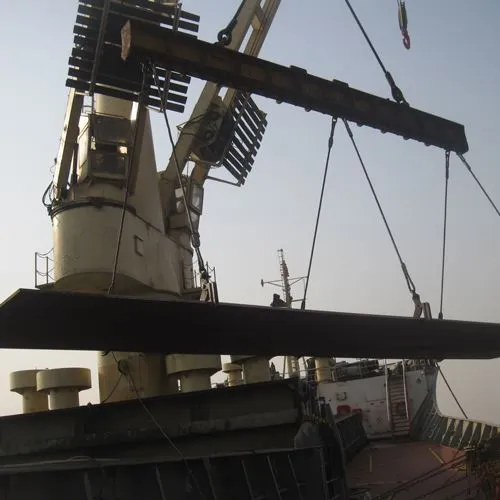
What is EN 10025-3 S355N Steel?
S355N is a weldable fine-grain structural steel supplied in the normalized or normalized rolled condition, as specified under the European standard EN 10025-3. It belongs to the High-Strength Low-Alloy (HSLA) steel category.
As a hot-rolled structural product, it belongs to the same strength family as S355J0, S355K2, and S355J2, but offers superior grain refinement.
- Tensile Strength (Rm): 470 – 630 MPa.
- Main Applications: Heavy-duty welded structures, including large ships, bridges, power station equipment, medium-to-high pressure boilers, pressure vessels, railway rolling stock, lifting machinery, and mining equipment.
1. Applicable Standard
Standard: EN 10025-3:2004
Title: Hot rolled products of structural steels - Part 3: Technical delivery conditions for normalized/normalized rolled weldable fine grain structural steels.
2. Grade Designation
"S": Denotes Structural Steel.
"355": Indicates a minimum yield strength (ReH) of 355 MPa.
"N": Indicates the delivery condition as Normalized or Normalized Rolled.
3. Specifications, Shape, Weight, and Tolerances
The dimensions, shape, and permissible tolerances of the steel plates shall comply with the requirements defined in EN 10025-1:2004, Section 2.2.
4. Delivery Condition
S355N plates are typically delivered in a normalized condition or via equivalent normalized rolling.
If specified, the product must be marked with the suffix "+N" or "+AR" (As-Rolled) to indicate the delivery state.
Plates are supplied with sheared or flame-cut edges.
5. Through-Thickness (Z-Direction) Properties
S355N can be produced with guaranteed Z-direction performance (resistance to lamellar tearing) to levels Z15, Z25, or Z35.
6. Z-Direction Technical Requirements
Z-direction properties (through-thickness ductility) are essential for "lamellar tearing resistant steel." This requires strict control over sulfur content and thickness-direction ductility.
Sulfur (S) Content Control:
Z15:S≤0.010%
Z25:S≤0.007%
Z35:S≤0.005%
Reduction of Area (Z value) Requirements:
Z15: Average value≥15%;
individual test≥10%.
Z25: Average value≥25%;
individual test≥15%.
Z35: Average value≥35%;
individual test≥25%.
Non-Destructive Testing: Z-direction properties inherently include Level 3 Ultrasonic Testing (UT).
2.Chemical Composition of EN 10025-3 S355N Steel
Table 1: S355N Chemical Composition (Ladle Analysis)
| Grade | C | Si | Mn | P | S | Ni | Cr |
| S355N |
≤0.20≤0.20 |
0.20∼0.500.20∼0.50 |
1.20∼1.601.20∼1.60 |
≤0.025≤0.025 |
≤0.015≤0.015 |
≤0.30≤0.30 |
≤0.30≤0.30 |
| Mo | Cu | Nb | V | Ti | Al (Total) | N | CEV Max |
|
≤0.10≤0.10 |
≤0.30≤0.30 |
≤0.05≤0.05 |
≤0.08≤0.08 |
≤0.03≤0.03 |
≥0.015≥0.015 |
≤0.009≤0.009 |
≤0.42≤0.42 |
S355N Mechanical Properties
| Grade | Product Form | Delivery Condition | Thickness (t,mm) | Test Parameters | Values | Remarks |
| S355N | Plate | Normalized |
t≤16t≤16 |
Yield Strength (ReL) |
≥355MPa |
|
| Tensile Strength (Rm) |
490∼630MPa |
|||||
| Elongation (A) |
≥22% |
|||||
| Impact Temp / Energy | -20°C /≥47J | Longitudinal | ||||
| Bend Diameter |
3a(a= thickness) |
|||||
| Bend Angle | 180° | |||||
| Sampling Note | Transverse sampling for tensile testing | |||||
| S355N |
16<t≤35 |
Yield Strength (ReL) |
≥355MPa |
|||
| Tensile Strength (Rm) |
490∼6304MPa |
|||||
| Elongation (A) |
≥22% |
|||||
| Impact Temp / Energy | -20°C /≥47J | Longitudinal | ||||
| Bend Diameter |
3a(a= thickness) |
|||||
| Bend Angle | 180° | |||||
| Sampling Note | Transverse sampling for tensile testing | |||||
| S355N | 35<t≤50 | Lower Yield Strength (ReL) | ≥345MPa | |||
| Tensile Strength (Rm) | 490∼630MPa | |||||
| Elongation after Fracture (A) | ≥22% | |||||
| Impact Test Temperature | -20°C | |||||
| Impact Energy (AKV) | ≥47J | |||||
| Bending Mandrel Diameter | 3a(a= thickness) | Longitudinal | ||||
| Bending Angle | 180° | |||||
| Technical Note | Transverse sampling for tensile testing |
Applicable Ultrasonic Testing (UT) Standards
The material can be inspected according to the following international and domestic non-destructive testing (NDT) standards:
- Chinese Standards (GB): GB/T 2970
- Energy Industry Standards (NB): NB/T 47013.3-2015
- Machinery Industry Standards (JB): JB/T 4730
- Japanese Industrial Standards (JIS): JIS G 0801
- European Standards (EN): EN 10160
- American Standards (ASME): ASME SA-578 / SA-578M, etc.
Minimum Longitudinal V-Notch Charpy Impact Energy (Akv) for S355N (Normalized)
| Grade | Minimum Impact Energy (J) at Test Temperature (°C) | ||||||
| +20 | 0 | -10 | -20 | -30 | -40 | -50 | |
| S355N | 55 | 47 | 43 | 40 | - | - | - |
Minimum Transverse V-Notch Charpy Impact Energy (Akv) for S355N (Normalized)
| Grade | Minimum Impact Energy (J) at Test Temperature (°C) | ||||||
| +20 | 0 | -10 | -20 | -30 | -40 | -50 | |
| S355N | 31 | 27 | 24 | 20 | - | - | - |
What is the Difference Between EN 10025-3 S355N and S355NL / S355M / S275N?
Key differences guide material selection:
EN 10025-3 S355N vs S355NL: Both have 355 MPa yield, but S355NL ensures impact toughness at -50°C (vs -20°C for EN 10025-3 S355N), ideal for colder climates. Visit EN 10025-3 S355NL normalized structural steel plate.
EN 10025-3 S355N vs S355M: S355M uses thermomechanical controlled processing (TMCP) for finer grain structure and cost-effective welding, while EN 10025-3 S355N's normalization suits broader applications.
EN 10025-3 S355N vs S275N: S355N offers higher yield (355 MPa vs 275 MPa) for stronger, lighter designs at a higher cost; S275N is more economical for lighter loads.
Is EN 10025-3 S355N steel good for welding?
Yes; CEV ≤0.43% allows straightforward arc welding without special aids.
What temperature can EN 10025-3 S355N be used in?
From -20°C to +500°C, with toughness certified at -20°C; use S355NL for colder conditions.
Does EN 10025-3 S355N require preheating when welding?
Not for ≤20 mm; 100-150°C recommended for thicker plates.
Is EN 10025-3 S355N equivalent to ASTM A572?
Comparable to A572 Grade 60 (yield ~415 MPa equivalent), but EN 10025-3 S355N's normalization enhances toughness; not identical.
What is the maximum thickness for EN 10025-3 S355N?
Up to 250 mm, with properties adjusted to maintain performance.
Can EN 10025-3 S355N be used in bridge construction?Y
es; suitable for secondary elements in temperate zones due to strength and -20°C toughness.
What differs between EN 10025-3 S355N and EN 10025-2 S355JR?
EN 10025-3 S355N is normalized fine-grain for -20°C, while S355JR is hot-rolled for ambient use without guaranteed low-temp properties.
How does EN 10025-3 S355N compare to Chinese Q345D?
Q345D is similar in strength and -20°C performance, but EN 10025-3 S355N adheres to stricter EU standards for grain control and certification.
Is EN 10025-3 S355N suitable for heavy machinery?
Yes; its strength and weldability make it ideal for equipment frames and supports in moderate environments.
Hot Tags: en 10025-3 s355n normalized structural steel plate, China en 10025-3 s355n normalized structural steel plate manufacturers, suppliers, factory, hsla steel plate specification, hsla steel plate packaging, hsla steel plate heat treatment properties, S550QL1 High Tensile Steel Sheet, hsla steel plate elongation, S500QL1 Low Alloy Structural Steel


