



As a leading provider of metallurgically bonded solutions, we offer A516 Gr.70 + 304 clad steel plates-a cost-efficient, high-performance answer to the dual challenges of structural pressure and aggressive corrosion.
GNEE is the world's leading manufacturer of roll-bonded clad plates. We offer clad plates, clad heads and clad cones from a single source. As a manufacturer with several decades of experience in roll bonding, we are your reliable partner in the linepipe, pressure vessel and apparatus industry. We understand our customers, provide the quality they need and have a large capacity to produce roll-bonded clad plates. These plates provide manufacturing and cost benefits during further processing.

Technical Composition & Structure
Base Material: ASTM A516 Grade 70
A standard for medium- and lower-temperature pressure vessels. It provides the necessary yield strength, tensile strength, and notch toughness to withstand high-pressure loads.
Cladding Material: AISI 304 Stainless Steel
The industry-standard "18/8" stainless steel provides a reliable protective barrier against organic and inorganic acids, oxidation, and atmospheric corrosion.

DEFINITION
» Metallurgically bonded composite of two or more layers
» The bond is created by high temperature and high pressure during hot rolling
» A typical combination is a thin corrosion-resistant alloy (CRA) as clad material and a thick carbon steel as base material
A516Gr70+304 Clad steel plate Chemical Composition and Mechanical Property
|
ASTM A516 Grade 70 Chemical Composition |
|||||
|
Grade |
The Element Max (%) |
||||
|
C |
Si |
Mn |
P |
S |
|
|
ASTM A516 grade 70 |
|||||
|
Thick <12.5mm |
0.27 max |
0.15–0.40 |
0.85–1.20 |
0.035 |
0.035 |
|
Thick12.5-50mm |
0.27 max |
0.15–0.40 |
0.85–1.20 |
0.035 |
0.035 |
|
Thick50-100mm |
0.27 max |
0.15–0.40 |
0.85–1.20 |
0.035 |
0.035 |
|
Thick100-200mm |
0.27 max |
0.15–0.40 |
0.85–1.20 |
0.035 |
0.035 |
|
Thick>200mm |
0.27 max |
0.15–0.40 |
0.85–1.20 |
0.035 |
0.035 |
|
Element |
Percentage (%) |
|
Carbon (C) |
0.27 max |
|
Manganese (Mn) |
0.85–1.20 |
|
Phosphorus (P) |
0.035 max |
|
Sulfur (S) |
0.035 max |
|
Silicon (Si) |
0.15–0.40 |
|
Nickel (Ni) |
0.40 max (optional) |
|
Chromium (Cr) |
0.30 max (optional) |
|
Molybdenum (Mo) |
0.08 max (optional) |
|
Grade |
ASTM A516 Grade 70 Mechanical Property |
|||
|
Thickness |
Yield |
Tensile |
Elongation |
|
|
ASTM A516 grade 70 |
mm |
Min Mpa |
Mpa |
Min % |
|
6-40 |
260 |
485-620 |
21% |
|
|
40-100 |
260 |
485-620 |
17% |
|
| Grade |
C
|
Mn |
P
|
S
|
Si |
Cr |
Ni | Mo | Ni |
Cooper
|
| 304(S30400) | 0.07 | 2.0 | 0.045 | 0.030 | 0.75 | 17.5-19.5 | 8.0-10.5 | - | 0.10 | - |
| Grade |
Yield strength (N/mm2), min |
Tensile strength (N/mm2), min |
Elongationin 2 in. (50mm), %, min |
|
Cold bend | ||||||
|
Austenitic (Chromium-Nickel) (Chromium-Manganese-Nickel) |
|||||||||||
| 304(S30400) |
|
|
40 |
|
not required | ||||||
A516Gr70+304 Clad steel plate Application
As reliable partner for roll-bonded clad plates, our typical fields of applicationare the oil and gas production, refinery, petrochemical and chemical industryas well as flue gas desulphurisation plants and power plants.
OIL AND GAS PRODUCTION
» Clad flowlines» Catenary riser pipes» Slug catchers
REFINERIES, PETROCHEMICAL AND CHEMICAL INDUSTRY
» Fractionators» Vacuum towers» Coke drums» Process pipes» Columns» Pressure vessels» Reactors» Washers» Heat exchangers
FLUE GAS DESULPHURISATION PLANTS
» Flue gas channels» Chimneys» Flue gas scrubbers
POWER PLANTS
» Accumulator tanks» Other applications
ICEBREAKER VESSELS
» Ship hulls
Our roll-bonded plates and heads are used in chemical apparatus engineering and refineries, in the oil and gas industry, in oil sand processing (coke drums) and in the food industry. Clad plates are used in seawater desalination and flue gas desulfurization systems.
Widely used in natural environments such as bridge construction, roll-bonded clad plates offer outstanding properties including high aesthetic appeal and significantly reduced maintenance and servicing costs-making them the ideal choice for durable and demanding structures.
The food industry also benefits from our solutions: the stainless steel cladding meets the highest hygiene standards, while the carbon steel core enables rapid heating and efficient heat transfer.

ADVANTAGES OF ROLL-BONDED CLAD PLATES
Advantages in comparison to solid corrosion-resistant alloy (CRA) plates:
» Reduced material cost » Less weight due to reduction of wall thicknesses
» Reduction of weld length due to larger dimensions
» Lower cost of filler metal
» Superior heat conductivity
Advantages in comparison to explosive cladding:
» Higher bonding quality
» Reduction of weld length due to larger dimensions
» Use of thinner clad material is possible
» No welds in the claddings for wide plates
Advantages in comparison to overlay welding:
» Improved surface quality
» No dilution from the base material
» Homogenous chemical composition
CLAD LINEPIPE PLATES
We are the world's largest producer of roll-bonded clad linepipe plates.Roll-bonded clad plates are used for the manufacturing of clad linepipes.
HIGHEST RESISTANCE TO SOUR GAS
Roll-bonded clad plates are used for the manufacturing of clad linepipes. The sour gases occurring in linepipes used for the transport of oil and gas are highly corrosive.
Only the highest alloyed materials are capable to withstand this aggressive medium.
Our roll-bonded clad linepipe plates with corrosion-resistant claddings meet these extreme requirements. We are the world's largest producer of roll-bonded clad linepipe plates.
TMCP AND PROTECTIVE CLADDING
We provide thermomechanically rolled and accelerated cooled (TMCP) clad plates. This in-line process leads to high strength and excellent toughness combined with best weldability of the base material and maintains the extreme corrosion resistance of the protective cladding.
A typical material combination is X65 with nickel-based alloy 825 or 625 as cladding.
METALLURGICAL BOND
Our pipe partners process these clad plates into metallurgically bonded clad linepipes. The metallurgical bonding of the clad linepipes withstands the highest mechanical stress and dynamic loads, making the pipes especially suited to deep-sea applications under highly corrosive conditions.
REELING AND RISER PIPES
» Cost-efficient reeling of pipelines in comparison to on-board welding
» Roll-bonded clad plates for risers, bends and fittings
» Excellent properties of metallurgically bonded clad plates for the highest degree of compression strength
DELIVERY CONDITION
The conventional delivery condition of clad plates used for clad pipes is quenched and tempered. We also can provide thermomechanically rolled and accelerated cooled (TMCP) clad plates. This online processing leads to high strength and excellent toughness combined with best weldability of the base material and properly maintains corrosion properties of the clad material.

CLAD HEADS AND CONES
We produce clad heads and clad cones from roll-bonded clad plates in-house. We supply shell plates, heads and cones for pressure vessel manufacturing from a single source.
PLATES, HEADS AND CONES FROM ONE SOURCE
Benefits for our customers
» Advantages in processing, especially regarding welding when using the same steel for shell plates and heads
» Technical support and coordination from one research and quality department
» Coordinated production and delivery of shell plates and heads from a single source
» Reduced costs for our customers
CLADDINGS
We offer ferritic and austenitic stainless steels (Cr, CrNi, CrNiMo), nickel and nickel-based alloys, copper and copper-nickel-alloys as cladding materials for clad heads and cones.
PRODUCTS AND DIMENSIONS
| Type | Specification | |
|---|---|---|
 |
single‑piece heads (pressed) | diameter: max. 3,700 mm*thickness: max. 160 mm |
 |
single‑piece heads (flanged) | diameter: max. 6,500 mm*thickness: max. 65 mm*from 3,400 – 6,500 mm with one weld seam |
 |
multi‑piece heads (pressed) | diameter: max. 12,000 mmthickness: max. 120 mm |
 |
multi‑piece cones (pressed) | diameter: max. 12,000 mmthickness: max. 120 mm |
|
» Belt grinding or glass-bead blasting of clad surface » Edge preparation for welding » Heat treatment corresponding to material requirements; water quenching up to a diameter of 6,500 mm |
||

Clad Steel Plate Quality
The high quality of roll-bonded clad plates is based on the mechanical properties of the base material, optimally combined with the corrosion resistance of the cladding material. Our materials fulfill the highest toughness properties (e.g. Drop Weight Tear Test, Charpy Impact Test and CTOD Test) and even HIC properties in the base material depending on the material combinations and plate thicknesses. A perfect surface finish completes this high-end product.
BOND QUALITY
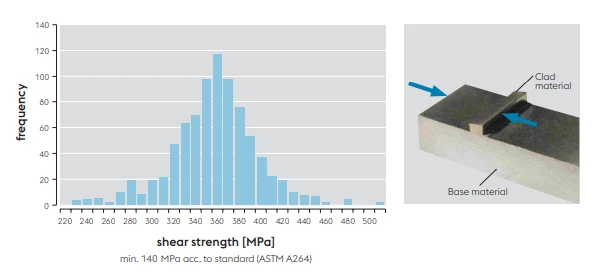
The metallurgical bond between base and clad material is created by high pressure at high temperature during the hot rolling process. The bond is inseparable and far exceeds the minimum shear strength of 140 MPa required by ASTM.
CORROSION RESISTANCE The corrosion resistance of clad material is equivalent to that of solid material.

HEAT TREATMENT
Based on the chemical composition, the mechanical-technological properties of the base material as well as the corrosion properties of the clad material are adjusted by choosing the appropriate production route and heat treatment.
» As rolled with simulated heat treatment
» Normalizing rolled» Normalized (furnace)
» Normalized and tempered
» Quenched and tempered
» Thermomechanically rolled and accelerated cooled (TMCP)
SURFACE FINISH
The surface of the base material is usually "as rolled" or shot blasted. The surface of the clad material is usually ground with a grain size of 80. Other grain sizes are available on request. Any additional future surface treatment (e.g. fine grinding) of the clad surface by the customer must be indicated.
REFERENCE VALUES FOR ROUGHNESS
» Clad material: ferritic and austenitic stainless steel, nickel-based alloys
| Item | Value |
|---|---|
| Grain size | 80 |
| Depth of roughness Rt in μm | < 40 |
| Mean roughness Ra in μm | < 4.5 |
» Clad material: copper and copper alloys, nickel
Copper and copper alloys as well as nickel clad plates are ground with a grain size of 120.

Clad Steel Plate Process

DIMENSIONS
Depending on the type of clad material we can provide various dimensions. The clad materials mainly used are ferritic and austenitic stainless steels, nickel and nickel-based alloys and copper alloys.
» Clad material: ferritic and austenitic stainless steel
| Item | Specification |
|---|---|
| Total thickness | 6 - 150 mm |
| Clad thickness | 1.5 - 10 mm |
| Width | max. 3,800 mm |
| Length | max. 15,000 mm ¹ |
| Water quenched | max. 12,400 mm ¹ |
| Weight per plate | min. 2 t / max. 20 t |
| Area | min. 6 m² |
» Clad material: copper alloys
| Item | Specification |
|---|---|
| Total thickness | 6 - 65 mm |
| Clad thickness | 1.5 - 10 mm |
| Width | max. 3,800 mm |
| Length | max. 15,000 mm ¹ |
| Water quenched | max. 12,400 mm ¹ |
| Weight per plate | min. 2 t / max. 20 t |
| Area | min. 6 m² |
» Clad material: nickel alloys 625, 825
| Item | Specification |
|---|---|
| Total thickness | 6 - 120 mm |
| Clad thickness | 1.5 - 10 mm |
| Width | max. 3,800 mm |
| Length | max. 15,000 mm ¹ |
| Water quenched | max. 12,400 mm ¹ |
| Weight per plate | min. 2 t / max. 14 t |
| Area | min. 6 m² |
¹ Further dimensions upon request

Materials
A roll-clad sheet or plate consists of a base and a coating layer material.
The base materials for our clad plates come 100% from our own steel production in Linz. Cladding materials are purchased in the form of slabs and plates from renowned manufacturers.
The base materials used are primarily structural steels, boiler and pressure vessel steels and fine-grained structural steels that are characterized by good weldability and workability.
As cladding materials, we supply ferritic and austenitic stainless steels, nickel and nickel-based alloys, copper and copper-nickel alloys that are characterized by their respective corrosion properties.
Further details can be found in the brochure linked below.
The surfaces of the base materials are usually supplied in as-rolled condition or are sandblasted.
The surface of the cladding material is usually ground. We supply ground with grain 80 as a standard. Further grindings can be supplied upon request.
clad steel plate BASE MATERIALS
We mainly use
» Structural steels
» Pressure vessel steels
» Linepipe steels
Depending on the requirements of the respective standards and customer specifications as well as on the required corrosion resistance of the cladding materials, we provide the following delivery conditions:
» As rolled with simulated testing
» Normalizing rolled
» Normalized (furnace)
» Normalized and tempered
» Quenched and tempered
» Thermomechanically rolled and accelerated cooled (TMCP)
BASE MATERIALS: STRUCTURAL STEELS AND PRESSURE VESSEL STEELS (EN 10025-2, EN 10028-2, EN 10028-3)
| Standard | Steel grade | Chemical composition (heat analysis) % | Mechanical properties | |||||||||
|---|---|---|---|---|---|---|---|---|---|---|---|---|
| C ¹) max. | Si max. | Mn max. | P max. | S max. | Cr max. | Ni max. | Mo max. | Yield strength ¹) min.[MPa] | Tensile strength ¹) [MPa] | Comparable grade ASTM-steel grade | ||
| EN 10025-2 | S235JR | 0.17 | - | 1.40 | 0.035 | 0.035 | - | - | - | 235 | 360 - 510 | - |
| S355JR | 0.24 | 0.55 | 1.60 | 0.035 | 0.035 | - | - | - | 355 | 510 - 680 | - | |
| EN 10028-2 | P235GH | 0.16 | 0.35 | 0.60 - 1.20 | 0.025 | 0.010 | 0.30 | 0.30 | 0.08 | 235 | 360 - 480 | A285 GradeC |
| P265GH | 0.20 | 0.40 | 0.80 - 1.40 | 0.025 | 0.010 | 0.30 | 0.30 | 0.08 | 265 | 410 - 530 | A516 Grade60 | |
| P295GH | 0.08 - 0.20 | 0.40 | 0.90 - 1.50 | 0.025 | 0.010 | 0.30 | 0.30 | 0.08 | 295 | 460 - 580 | A516 Grade65 | |
| P355GH | 0.10 - 0.22 | 0.60 | 1.10 - 1.70 | 0.025 | 0.010 | 0.30 | 0.30 | 0.08 | 355 | 510 - 650 | A516 Grade70 | |
| 16Mo3 | 0.12 - 0.20 | 0.35 | 0.40 - 0.90 | 0.025 | 0.010 | 0.30 | 0.30 | 0.25 - 0.35 | 275 | 440 - 590 | - | |
| 20MnMoNi4-5 | 0.15 - 0.23 | 0.40 | 1.00 - 1.50 | 0.020 | 0.010 | 0.20 | 0.40 - 0.80 | 0.45 - 0.60 | 470 | 590 - 750 | A533 Type B Class2 | |
| 13CrMo4-5 | 0.08 - 0.18 | 0.35 | 0.40 - 1.00 | 0.025 | 0.010 | 0.70 - 1.15 | - | 0.40 - 0.60 | 300 | 450 - 600 | A387 Grade12 Class2 | |
| 10CrMo9-10 | 0.08 - 0.14 | 0.50 | 0.40 - 0.80 | 0.020 | 0.010 | 2.00 - 2.50 | - | 0.90 - 1.10 | 310 | 480 - 630 | - | |
| 12CrMo9-10 | 0.10 - 0.15 | 0.30 | 0.30 - 0.80 | 0.015 | 0.010 | 2.00 - 2.50 | 0.30 | 0.90 - 1.10 | 355 | 540 - 690 | A387 Grade22 Class2 | |
| 13CrMoV9-10 | 0.11 - 0.15 | 0.10 | 0.30 - 0.60 | 0.015 | 0.005 | 2.00 - 2.50 | 0.25 | 0.90 - 1.10 | 455 | 600 - 780 | A542 Type D Class4 | |
| EN 10028-3 | P275 NH | 0.16 | 0.40 | 0.80 - 1.50 | 0.025 | 0.010 | 0.30 | 0.50 | 0.08 | 275 | 390 - 510 | A516 Grade60 |
| P275 NL1 | 0.16 | 0.40 | 0.80 - 1.50 | 0.025 | 0.008 | 0.30 | 0.50 | 0.08 | 275 | 390 - 510 | A516 Grade60 | |
| P275 NL2 | 0.16 | 0.40 | 0.80 - 1.50 | 0.020 | 0.005 | 0.30 | 0.50 | 0.08 | 275 | 390 - 510 | A516 Grade60 | |
| P355 NH | 0.18 | 0.50 | 1.10 - 1.70 | 0.025 | 0.010 | 0.30 | 0.50 | 0.08 | 355 | 490 - 630 | A516 Grade70 | |
| P355 NL1 | 0.18 | 0.50 | 1.10 - 1.70 | 0.025 | 0.008 | 0.30 | 0.50 | 0.08 | 355 | 490 - 630 | A516 Grade70 | |
| P355 NL2 | 0.18 | 0.50 | 1.10 - 1.70 | 0.020 | 0.005 | 0.30 | 0.50 | 0.08 | 355 | 490 - 630 | A516 Grade70 | |
| P460 NH | 0.20 | 0.60 | 1.10 - 1.70 | 0.025 | 0.010 | 0.30 | 0.80 | 0.10 | 460 | 570 - 730 | A572 Grade65 | |
| P460 NL1 | 0.20 | 0.60 | 1.10 - 1.70 | 0.025 | 0.008 | 0.30 | 0.80 | 0.10 | 460 | 570 - 730 | A572 Grade65 | |
| P460 NL2 | 0.20 | 0.60 | 1.10 - 1.70 | 0.020 | 0.005 | 0.30 | 0.80 | 0.10 | 460 | 570 - 730 | A572 Grade65 | |
BASE MATERIALS: STRUCTURAL STEELS AND PRESSURE VESSEL STEELS (ASTM)
| Standard | Steel grade | Chemical composition (heat analysis) % | Mechanical properties | Comparable steel grade of EN 10028 | ||||||||
|---|---|---|---|---|---|---|---|---|---|---|---|---|
| C ¹)²) max. | Si max. | Mn ²) max. | P max. | S max. | Cr max. | Ni max. | Mo max. | Yield strength ¹) min.[MPa] | Tensile strength ¹) [MPa] | |||
| ASTM | A285 GradeC | 0.28 | - | 0.90 | 0.025 | 0.025 | - | - | - | 205 | 380 - 515 | P235GH |
| A516 Grade60 | 0.21 | 0.15 - 0.40 | 0.60 - 0.90 | 0.025 | 0.025 | - | - | - | 220 | 415 - 550 | P275 | |
| A516 Grade65 | 0.24 | 0.15 - 0.40 | 0.85 - 1.20 | 0.025 | 0.025 | - | - | - | 240 | 450 - 585 | P355 | |
| A516 Grade70 | 0.27 | 0.15 - 0.40 | 0.85 - 1.20 | 0.025 | 0.025 | - | - | - | 260 | 485 - 620 | P355 | |
| A572 Grade65 Type 1 | 0.23 | 0.40 | 1.65 | 0.040 | 0.050 | - | - | - | 450 | ≥ 550 | P460 | |
| A204 Grade A | 0.18 | 0.15 - 0.40 | 0.90 | 0.025 | 0.025 | - | - | 0.45 - 0.60 | 255 | 450 - 585 | 16Mo3 | |
| A204 Grade B | 0.20 | 0.15 - 0.40 | 0.90 | 0.025 | 0.025 | - | - | 0.45 - 0.60 | 275 | 485 - 620 | 16Mo3 | |
| A302 Grade B | 0.20 | 0.15 - 0.40 | 1.15 - 1.50 | 0.025 | 0.025 | - | - | 0.45 - 0.60 | 345 | 550 - 690 | 18MnMo4-5 | |
| A533 Type B Class1 | 0.25 | 0.15 - 0.40 | 1.15 - 1.50 | 0.025 | 0.025 | - | 0.40 - 0.70 | 0.45 - 0.60 | 345 | 550 - 690 | 20MnMoNi4-5 | |
| A533 Type B Class2 | 0.25 | 0.15 - 0.40 | 1.15 - 1.50 | 0.025 | 0.025 | - | 0.40 - 0.70 | 0.45 - 0.60 | 485 | 620 - 795 | 20MnMoNi4-5 | |
| A387 Grade11 Class2 | 0.05 - 0.17 | 0.50 - 0.80 | 0.40 - 0.65 | 0.025 | 0.025 | 1.00 - 1.50 | - | 0.45 - 0.65 | 310 | 515 - 690 | 13CrMoSi5-5 | |
| A387 Grade12 Class2 | 0.05 - 0.17 | 0.15 - 0.40 | 0.40 - 0.65 | 0.025 | 0.025 | 0.80 - 1.15 | - | 0.45 - 0.60 | 275 | 450 - 585 | 13CrMo4-5 | |
| A387 Grade22 Class2 | 0.05 - 0.15 | 0.50 | 0.30 - 0.60 | 0.025 | 0.025 | 2.00 - 2.50 | - | 0.90 - 1.10 | 310 | 515 - 690 | 12CrMo9-10 | |
| A542 Type D Class4 | 0.11 - 0.15 | 0.10 | 0.30 - 0.60 | 0.015 | 0.010 | 2.00 - 2.50 | 0.25 | 0.90 - 1.10 | 380 | 585 - 760 | 13CrMoV9-10 | |
| A841 Grade A Class1 | 0.20 | 0.15 - 0.50 | 0.70 - 1.60 | 0.030 | 0.030 | 0.25 | 0.25 | 0.08 | 345 | 485 - 620 | P355 | |
BASE MATERIALS: FITTING STEELS AND LINEPIPE STEELS (ASTM, API 5L, DNVGL-ST-F101)
| Standard | Steel grade | Chemical composition (heat analysis) % | Mechanical properties | Comparable steel grade of ASTM / DNVGL / API | ||||||||||
|---|---|---|---|---|---|---|---|---|---|---|---|---|---|---|
| C ¹)²) max. | Si max. | Mn ²) max. | P max. | S max. | Cr max. | Ni max. | Cu max. | Mo max. | V max. | Yield strength ¹) min.[MPa] | Tensile strength ¹) [MPa] | |||
| ASTM | A106 GradeB | 0.30 | 0.10 | 0.29 - 1.06 | 0.035 | 0.035 | 0.40 | 0.40 | 0.40 | 0.15 | 0.08 | 240 | ≥ 415 | ASTM A516 Grade65 |
| A672 GradeC60 | 0.21 | 0.15 - 0.40 | 0.60 - 0.90 | 0.025 | 0.025 | - | - | - | - | - | 220 | 415 - 550 | ASTM A516 Grade60 | |
| A672 GradeC70 | 0.27 | 0.15 - 0.40 | 0.85 - 1.20 | 0.025 | 0.025 | - | - | - | - | - | 260 | 485 - 620 | ASTM A516 Grade70 | |
| ASTM A860 | WPHY 42 | - | - | - | - | - | - | - | - | - | - | 290 | 415 - 585 | - |
| WPHY 52 | 0.20 | 0.15 - 0.40 | 1.00 - 1.45 | 0.030 | 0.010 | 0.30 | 0.50 | 0.35 | 0.25 | 0.10 | 360 | 455 - 625 | - | |
| WPHY 60 | 0.20 | 0.15 - 0.40 | 1.00 - 1.45 | 0.030 | 0.010 | 0.30 | 0.50 | 0.35 | 0.25 | 0.10 | 415 | 515 - 690 | - | |
| WPHY 65 | 0.20 | 0.15 - 0.40 | 1.00 - 1.45 | 0.030 | 0.010 | 0.30 | 0.50 | 0.35 | 0.25 | 0.10 | 450 | 530 - 705 | - | |
| API 5L | GradeB – PSL2 | 0.22 | 0.45 | 1.20 | 0.025 | 0.015 | - | - | - | - | - | 245 - 450 | 415 - 655 | DNVGL SAWL 245 |
| X52 – PSL2 | 0.22 | 0.45 | 1.40 | 0.025 | 0.015 | - | - | - | - | - | 360 - 530 | 460 - 760 | DNVGL SAWL 360 | |
| X60 – PSL2 | 0.12 | 0.45 | 1.60 | 0.025 | 0.015 | - | - | - | - | - | 415 - 565 | 520 - 760 | DNVGL SAWL 415 | |
| X65 – PSL2 | 0.12 | 0.45 | 1.60 | 0.025 | 0.015 | - | - | - | - | - | 450 - 600 | 535 - 760 | DNVGL SAWL 450 | |
| DNVGL-ST-F101 | SAWL 245 | 0.12 | 0.40 | 1.25 | 0.020 | 0.010 | 0.30 | 0.30 | 0.35 | 0.10 | 0.04 | 245 - 450 | 415 - 760 | API 5L GradeB |
| SAWL 360 | 0.12 | 0.45 | 1.65 | 0.020 | 0.010 | 0.50 | 0.50 | 0.50 | 0.50 | 0.05 | 360 - 525 | 460 - 760 | API 5L X52 | |
| SAWL 415 | 0.12 | 0.45 | 1.65 | 0.020 | 0.010 | 0.50 | 0.50 | 0.50 | 0.50 | 0.08 | 415 - 565 | 520 - 760 | API 5L X60 | |
| SAWL 450 | 0.12 | 0.45 | 1.65 | 0.020 | 0.010 | 0.50 | 0.50 | 0.50 | 0.50 | 0.10 | 450 - 570 | 535 - 760 | API 5L X65 | |
CLADDINGS: STAINLESS STEELS AND HEAT-RESISTANT STEELS
We mainly use
» Ferritic and austenitic stainless steels and heat-resistant steels
» Nickel and nickel-based alloys
» Copper and copper-alloys
EN 10088 / SEW 470 Grades
| Standard | EN material number | Steel grade | Chemical composition (heat analysis) % (extract) | Mean pitting resistance equivalent number (PREN) Cr+3.3Mo+16N [%] | Comparable ASTM A240 / ASME SA240 type | ||||||||
|---|---|---|---|---|---|---|---|---|---|---|---|---|---|
| C max. | Si max. | Mn max. | P max. | S max. | Cr | Ni | Mo | Others | |||||
| EN 10088 | 1.4000 | X6Cr13 | 0.08 | 1.0 | 1.0 | 0.040 | 0.030 | 12.0 - 14.0 | - | - | - | - | 410S |
| 1.4301 | X5CrNi18-10 | 0.07 | 1.0 | 2.0 | 0.045 | 0.030 | 17.5 - 19.5 | 8.0 - 10.5 | - | N ≤ 0.10 | - | 304 | |
| 1.4306 | X2CrNi19-11 | 0.03 | 1.0 | 2.0 | 0.045 | 0.030 | 18.0 - 20.0 | 10.0 - 12.0 | - | N ≤ 0.10 | - | 304L | |
| 1.4541 | X6CrNiTi18-10 | 0.08 | 1.0 | 2.0 | 0.045 | 0.030 | 17.0 - 19.0 | 9.0 - 12.0 | - | 5xC < Ti ≤ 0.70 | - | 321 | |
| 1.4550 | X6CrNiNb18-10 | 0.08 | 1.0 | 2.0 | 0.045 | 0.015 | 17.0 - 19.0 | 9.0 - 12.0 | - | 10xC < Nb ≤ 1.00 | - | 347 | |
| 1.4401 | X5CrNiMo17-12-2 | 0.07 | 1.0 | 2.0 | 0.045 | 0.030 | 16.5 - 18.5 | 10.0 - 13.0 | 2.0 - 2.5 | N ≤ 0.10 | 25 | 316 | |
| 1.4404 | X2CrNiMo17-12-2 | 0.03 | 1.0 | 2.0 | 0.045 | 0.030 | 16.5 - 18.5 | 10.0 - 13.0 | 2.0 - 2.5 | N ≤ 0.10 | 25 | 316L | |
| 1.4571 | X6CrNiMoTi17-12-2 | 0.08 | 1.0 | 2.0 | 0.045 | 0.030 | 16.5 - 18.5 | 10.5 - 13.5 | 2.0 - 2.5 | 5xC < Ti ≤ 0.70 | 25 | 316Ti | |
| 1.4432 | X2CrNiMo17-12-3 | 0.03 | 1.0 | 2.0 | 0.045 | 0.030 | 16.5 - 18.5 | 10.5 - 13.0 | 2.5 - 3.0 | N ≤ 0.10 | 27 | 316L Mod Mo ≥ 2.5 | |
| 1.4435 | X2CrNiMo18-14-3 | 0.03 | 1.0 | 2.0 | 0.045 | 0.030 | 17.0 - 19.5 | 12.5 - 15.0 | 2.5 - 3.0 | N ≤ 0.10 | 28 | 316L Mod Mo ≥ 2.5 | |
| 1.4429 | X2CrNiMoN17-13-3 | 0.03 | 1.0 | 2.0 | 0.045 | 0.015 | 16.5 - 18.5 | 11.0 - 14.0 | 2.5 - 3.0 | N = 0.12 - 0.22 | 29 | 316LN Mod Mo ≥ 2.5 | |
| 1.4438 | X2CrNiMo18-15-4 | 0.03 | 1.0 | 2.0 | 0.045 | 0.030 | 17.5 - 19.5 | 13.0 - 16.0 | 3.0 - 4.0 | N ≤ 0.10 | 31 | 317L | |
| 1.4439 | X2CrNiMoN17-13-5 | 0.03 | 1.0 | 2.0 | 0.045 | 0.030 | 16.5 - 18.5 | 12.5 - 14.5 | 4.0 - 5.0 | N = 0.12 - 0.22 | 35 | 317LMN | |
| SEW 470 | 1.4828 | X15CrNiSi20-12 | 0.20 | 1.5 - 2.5 | 2.0 | 0.045 | 0.015 | 19.0 - 21.0 | 11.0 - 13.0 | - | N ≤ 0.10 | - | - |
ASTM A240 / ASME SA240 Grades
| Standard | UNS number | Steel grade | Chemical composition (heat analysis) % (extract) | Mean pitting resistance equivalent number (PREN) Cr+3.3Mo+16N [%] | Comparable grade of EN 10088 | ||||||||
|---|---|---|---|---|---|---|---|---|---|---|---|---|---|
| C max. | Si max. | Mn max. | P max. | S max. | Cr | Ni | Mo | Others | |||||
| ASTM A240 and ASME SA240 | S41008 | 410S | 0.08 | 1.00 | 1.0 | 0.040 | 0.030 | 11.5 - 13.5 | max. 0.60 | - | - | - | 1.4000 |
| S30400 | 304 | 0.07 | 0.75 | 2.0 | 0.045 | 0.030 | 17.5 - 19.5 | 8.0 - 10.5 | - | N ≤ 0.10 | - | 1.4301 | |
| S30403 | 304L | 0.03 | 0.75 | 2.0 | 0.045 | 0.030 | 17.5 - 19.5 | 8.0 - 12.0 | - | N ≤ 0.10 | - | 1.4306 | |
| S32100 | 321 | 0.08 | 0.75 | 2.0 | 0.045 | 0.030 | 17.0 - 19.0 | 9.0 - 12.0 | - | 5x(C+N) < Ti ≤ 0.70 | - | 1.4541 | |
| S34700 | 347 | 0.08 | 0.75 | 2.0 | 0.045 | 0.030 | 17.0 - 19.0 | 9.0 - 13.0 | - | 10xC < Nb ≤ 1.00 | - | 1.4550 | |
| S31600 | 316 | 0.08 | 0.75 | 2.0 | 0.045 | 0.030 | 16.0 - 18.0 | 10.0 - 14.0 | 2.0 - 3.0 | N ≤ 0.10 | 25 | 1.4401 | |
| S31603 | 316L | 0.03 | 0.75 | 2.0 | 0.045 | 0.030 | 16.0 - 18.0 | 10.0 - 14.0 | 2.0 - 3.0 | N ≤ 0.10 | 25 | 1.4404 | |
| - | 316L Mod Mo ≥ 2.5 | 0.03 | 0.75 | 2.0 | 0.045 | 0.030 | 16.0 - 18.0 | 10.0 - 14.0 | 2.5 - 3.0 | N = 0.10 - 0.16 | 27 | 1.4432/1.4435 | |
| S31635 | 316Ti | 0.08 | 0.75 | 2.0 | 0.045 | 0.030 | 16.0 - 18.0 | 10.0 - 14.0 | 2.0 - 3.0 | 5x(C+N) < Ti ≤ 0.70 | 25 | 1.4571 | |
| S31653 | 316LN | 0.03 | 0.75 | 2.0 | 0.045 | 0.030 | 16.0 - 18.0 | 10.0 - 14.0 | 2.0 - 3.0 | N = 0.10 - 0.16 | 27 | - | |
| - | 316LN Mod Mo ≥ 2.5 | 0.03 | 0.75 | 2.0 | 0.045 | 0.030 | 16.0 - 18.0 | 10.0 - 14.0 | 2.5 - 3.0 | N = 0.10 - 0.16 | 29 | 1.4429 | |
| S31703 | 317L | 0.03 | 0.75 | 2.0 | 0.045 | 0.030 | 18.0 - 20.0 | 11.0 - 15.0 | 3.0 - 4.0 | N ≤ 0.10 | 31 | 1.4438 | |
| S31726 | 317LMN | 0.03 | 0.75 | 2.0 | 0.045 | 0.030 | 17.0 - 20.0 | 13.5 - 17.5 | 4.0 - 5.0 | N = 0.10 - 0.20 | 35 | 1.4439 | |
CLADDINGS: SPECIAL STEELS, NON-FERROUS METALS AND ALLOYS
| ASTM | Alloy type | Chemical composition (heat analysis) % (extract) | Mean pitting resistance equivalent number (PREN) Cr+3.3Mo+16N [%] | EN material number | Comparable grades | |||||||||
|---|---|---|---|---|---|---|---|---|---|---|---|---|---|---|
| C max. | Si max. | Mn max. | P max. | S max. | Cr | Ni | Mo | Others | EN / DIN / SEW | VdTÜV material sheet | ||||
| B 409 UNS N08800 | Alloy 800 | 0.10 | 1.00 | 1.5 | 0.045 | 0.015 | 19.0 - 23.0 | 30.0 - 35.0 | - | Al = 0.15 - 0.60 Ti = 0.15 - 0.60 Cu ≤ 0.75, Fe ≥ 39.5 | - | 1.4876 | SEW 470 | 412 |
| A 240/A 240M UNS N08904 | Alloy 904 L | 0.02 | 1.00 | 2.0 | 0.045 | 0.035 | 19.0 - 23.0 | 23.0 - 28.0 | 4.0 - 5.0 | Cu = 1.0 - 2.0 N ≤ 0.10 | 36 | 1.4539 | - | 421 |
| B 709 UNS N08028 | Alloy 28 | 0.03 | 1.00 | 2.5 | 0.030 | 0.030 | 26.0 - 28.0 | 29.5 - 32.5 | 3.0 - 4.0 | Cu = 0.60 - 1.40 | 39 | 1.4563 | EN 10088 | - |
| B 677 UNS N08926 | Alloy 926 | 0.02 | 0.50 | 2.0 | 0.030 | 0.010 | 19.0 - 21.0 | 24.0 - 26.0 | 6.0 - 7.0 | Cu = 0.50 - 1.50 N = 0.15 - 0.25 | 44 | 1.4529 | - | 502 |
| B 463 UNS N08020 | Alloy 20 | 0.07 | 1.00 | 2.0 | 0.045 | 0.035 | 19.0 - 21.0 | 32.0 - 38.0 | 2.0 - 3.0 | Cu = 3.0 - 4.0 8xC < (Nb+Ta) < 1.0 | 28 | 2.4660 | DIN 17744 | - |
| B 424 UNS N08825 | Alloy 825 | 0.05 | 0.50 | 1.0 | - | 0.030 | 19.5 - 23.5 | 38.0 - 46.0 | 2.5 - 3.5 | Cu = 1.5 - 3.0 Ti = 0.60 - 1.20 Fe > 22.0, Al < 0.2 | 31 | 2.4858 | DIN 17744 | 432 |
| B 443 UNS N06625 | Alloy 625 | 0.10 | 0.50 | 0.5 | 0.015 | 0.015 | 20.0 - 23.0 | > 58.0 | 8.0 - 10.0 | Fe < 5.0, (Co < 1.0) Nb = 3.15 - 4.15 Al < 0.40, Ti < 0.40 | 51 | 2.4856 | DIN 17744 | 499 |
| B 575 UNS N06022 | Alloy C 22 | 0.015 | 0.08 | 0.5 | 0.020 | 0.020 | 20.0 - 22.5 | rest | 12.5 - 14.5 | Fe = 2.0 - 6.0 W = 2.5 - 3.5 V < 0.35, Co < 2.50 | 66 | 2.4602 | DIN 17744 | 479 |
| B 575 UNS N06455 | Alloy C 4 | 0.015 | 0.08 | 1.0 | 0.040 | 0.030 | 14.0 - 18.0 | rest | 14.0 - 17.0 | Fe < 3.0 Ti < 0.70 Co < 2.0 | 67 | 2.4610 | DIN 17744 | 424 |
| B 575 UNS N10276 | Alloy C 276 | 0.01 | 0.08 | 1.0 | 0.040 | 0.030 | 14.5 - 16.5 | rest | 15.0 - 17.0 | W = 3.0 - 4.5 Fe = 4.0 - 7.0 Co < 2.5, V < 0.35 | 68 | 2.4819 | DIN 17744 | 400 |
| B 575 UNS N06059 | Alloy 59 | 0.01 | 0.10 | 0.5 | 0.015 | 0.010 | 22.0 - 24.0 | rest | 15.0 - 16.5 | Al = 0.1 - 0.4 Fe < 1.5, Co < 0.3 Cu < 0.5 | 75 | 2.4605 | DIN 17744 | 505 |
| B 333 UNS N10665 | Alloy B 2 | 0.02 | 0.10 | 1.0 | 0.040 | 0.030 | 1.0 | rest | 26.0 - 30.0 | Fe < 2.0 Co < 1.00 | - | 2.4617 | DIN 17744 | 436 |
| B 168 UNS N06600 | Alloy 600 | 0.15 | 0.50 | 1.0 | - | 0.015 | 14.0 - 17.0 | > 72.0 | - | Fe = 6.0 - 10.0 Cu < 0.50 | - | 2.4816 | DIN 17742 | 305 |
| B 127 UNS N04400 | Alloy 400 | 0.30 | 0.50 | 2.0 | - | 0.024 | - | > 63.0 | - | Cu = 28.0 - 34.0 Fe < 2.5 | - | 2.4360 | DIN 17743 | 263 |
| B 162 UNS N02200 | Alloy 200 | 0.15 | 0.35 | 0.35 | - | 0.010 | - | > 99.00 | - | Fe < 0.4 Cu < 0.25 | - | 2.4066 | DIN 17740 | - |
| B 162 UNS N02201 | Alloy 201 | 0.02 | 0.35 | 0.35 | - | 0.010 | - | > 99.00 | - | Fe < 0.4 Cu < 0.25 | - | 2.4068 | - | 345 |
| B 152 UNS C10300 | Copper | - | - | - | 0.001 - 0.005 | - | - | - | - | Cu > 99.95 | - | 2.0070 | DIN 1787 | - |
| B 152 UNS C12200 | Copper | - | - | - | 0.015 - 0.040 | - | - | - | - | Cu > 99.90 | - | CW 024 A | - | - |
| B 171 UNS C70600 | Alloy CuNi 90/10 | - | - | 1.0 | - | - | - | 9.0 - 11.0 | - | Fe = 1.0 - 1.8, Cu rest, Zn < 1.0, Pb < 0.05 | - | CW 352 H | EN 1652 | 420 |
| B 171 UNS C71500 | Alloy CuNi 70/30 | 0.05 | - | 1.0 | - | - | - | 29.0 - 33.0 | - | Fe = 0.40 - 1.0, Cu rest Zn < 1.0, Pb < 0.05 | - | CW 354 H | - | - |
Typical Products
| Product | Steel grade | Thickness(mm) |
| Pipeline for Strongly acidic gas | S31254+Q345B | 8-20 |
| Nickel Based Alloy Clad Steel | 825+X65 | 3+22 |
| Cold-Rolled Steel Sheet for Elevator | 304L+BDT01+304L | |
| Special Ferritic Stainless Steel Clad Plate for the Application of Precast Concrete Mold | Special ferritic stainless stee+Q345 | 10 |
| Duplex Stainless Steel Clad Plate | S32205 +Q345C |
4+20 |
| Clad Plate for Wear-Resisting Pipe 30Cr13+Q235B | 30Cr13+Q235B | 6+8 |
| Clad plate for corrosion resistant pipeline | 316L+Q345B |
3+10
|
|
STEEL GRADE |
|
Q235B+304,Q345B+304,Q235B+304L,Q345B+304L,S355JR+410,A537CL1+410,A516Gr70+410, A516Gr70(NACE)+410,P265GH+410,S355JR+304,S355JR+304L,S355JR+316L,A516Gr70+304, A516Gr70+304L,A516Gr70+316,A516Gr70+316L,A537CL1+304,A537CL1+304L,A537CL1 +316L,P265GH+904L,A516Gr70+904L,A537CL1+904L |
Product Application
Electrical Engineering
For the steel liners used in sediment bottom holes, diversion bottom outlets, lock culverts and gates in hydropower industry, the basic requirements are high wear resistance, good impact resistance and adequate corrosion resistance. The liners are mainly used for silos, hoppers, chutes, dehydrators and other parts.
Due to the more strictly enviromental protection policies, some air desulfurization projects are applied in order to reduce SO2 in the air. For those projects, the clad steel plates will become the preferred material of thermal power plants.
Pressure Vessels, Storage Tanks
Clad steel plates can reduce the consumption of high price metals or alloys, and reduce project cost significantly. Clad steel has excellent mechanical properties. The base material and cladding layer can form strongly metallurgical combination.
Clad steel can be processed with a variety of hot pressing, bending, cutting, welding, etc. According to the applications of storage tanks, the base material can be selected from Q235B, Q345R carbon steels and other vessel steels. The cladding layer can be austenitic stainless steels such as 304, 316L, duplex stainless steel, and so on.
The materials and the thicknesses can be freely combined to meet the property requirements of the different chemical storage tanks.
Petrochemical Industry
Clad steel has been widely used as containers, towers, heat exchangers, pipes in petrochemical equipment. For refining high-sulfur, high-salt and high acidity crude oil, clad steel can replace carbon steel and stainless steel used in the main refining equipment such as vacuum towers, absorption towers, fractionating towers, and the stabilizers, which increases corrosion resistance, heat resistance, as well as the service life of equipment. The advantages of clad steel are more obvious in the development of oil and natural gas fields with high H2 S, SO and nitrogen ions.
Coal Chemical Industry
China has plentiful coal resources and the large-scale coal industry is demanding new energy-saving materials for its applications. Stainless steel clad plates have been widely used in the equipment of coal chemical gasification, liquefaction, coking and coal tar chemicals for their excellent performance.
Constructional Molding Plate
With the development of the construction industry, constructional mold plates will be extensively used. Currently carbon steel is mainly used as constructional mold plates on market.
Some pure ferritic and austenitic stainless steel are used in some high-end products. But the disadvantages of the carbon steel, pure ferritic stainless steel or pure austenitic stainless steel limit its use in the field of the constructional mold plates. For carbon steel, it has poor corrosion resistance, and low surface quality.
For ferritic stainless steel, it has very poor low temperature toughness, while for austenitic stainless steel, it does not have ferromagnetism which is important for the installation of side mold plates.
With the combination of carbon steel and ferritic stainless steel, the clad steel can obtain the best match of the corrosion resistance and toughness, and therefore it may have bright application prospects.
Mobile Containers and Ancillary Transport Equipment
For manufacturing tanks or dedicated tankers for glycol, olive oil, chemicals and other liquids.
|
Used for |
Stirred reactors, towers, heat exchangers, precipitation tanks, desalination equipment, dyeing equipment, evaporators, boiler, pressure shell, steam generators, guard plate, pipeline, ship plate, offshore construction, etc. |
||||||||
|
Applications |
Chemical, oil and gas, metallurgy, shipbuilding, power plant, etc. |
||||||||
|
Base plate Material |
Sedimentary Steel |
Chromium-molybdenum Steel |
Stainless Steel |
||||||
|
A516 Gr.60/70 A516 Gr.70 A572 Gr.50 A302 Gr.B/C A533 Gr.B/C A516 Gr.60/70 |
A387 Gr.12-2 A387 Gr.11-2 A387 Gr.22-2 |
SS304 SS316L |
|||||||
|
Flyer plate Material |
Chromium Stainless Steels |
Austenitic Stainless Steels |
Super Austenitic Stainless Steels |
Bidirectional Stainless Steels |
Nickel Alloys |
Titanium Alloys |
Copper Alloys |
Zirconium Alloys |
Aluminum Alloys |
|
SS430Ti SS430 |
SS304 S304L SS321 SS316L SS317L SS310S |
S31254 UNS N08904 UNS N08367 |
S31803 S32205 S32304 S32507 |
UNS N02200 UNS N02200 UNS N04400 UNS N10276 UNS N06022 UNS N06455 UNS N06600 UNS N06625 UNS N08800 UNS N08810 UNS N08825 |
Grade 1 Grade 2 Grade 3 Grade 4 Grade 9 Grade 11 |
C11000 C10100 C26800 C26000 C70600 C71500 C46400 C70600 C71500 |
UNS R60700 UNS R60702 UNS R60705 |
1060 |
|
Hot Tags: a516gr70+304 clad steel plate, China a516gr70+304 clad steel plate manufacturers, suppliers, factory


