


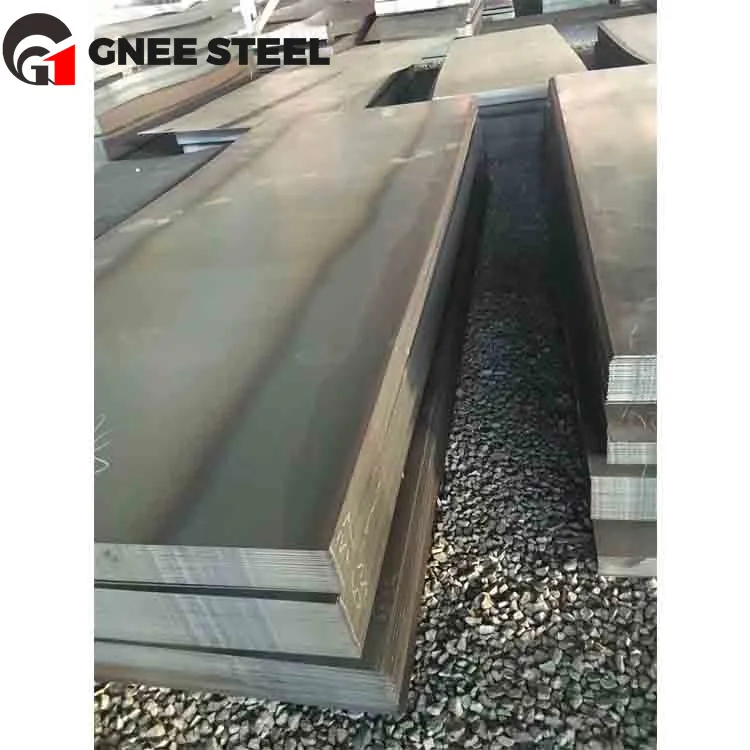


What is P355GH Steel Plate?

P355GH (Material No. 1.0473) is a non-alloy quality steel plate specified under EN 10028-2 for pressure equipment service. The "GH" suffix signifies guaranteed elevated-temperature performance (up to 400°C), while delivering the highest minimum yield strength (355 MPa) among all non-alloy carbon steel grades in this specification. It supersedes the withdrawn German DIN 17155 H I and British BS 1501-161-360A grades and is officially recognized as a harmonized material compliant with EU Pressure Equipment Directive (PED 2014/68/EU).
P355GH Pressure Vessels Steel Plate Specification
| Parameter | Specification |
|---|---|
| Thickness | 5 – 300 mm (mechanical properties to 250 mm) |
| Width | 1,500 – 4,050 mm |
| Length | 3,000 – 18,000 mm |
P355GH Steel Plate Chemical Composition
|
Element |
Max/Min (% by weight) |
|---|---|
|
Carbon (C) |
0.10 - 0.22 |
|
Manganese (Mn) |
1.10 - 1.70 |
|
Phosphorus (P) |
0.025 (max) |
|
Sulfur (S) |
0.015 (max) |
|
Silicon (Si) |
0.60 (max) |
|
Aluminum (Al) |
0.020 (min) |
|
Nitrogen (N) |
0.012 (max) |
|
Chromium (Cr) |
0.30 (max) |
|
Copper (Cu) |
0.30 (max) |
|
Molybdenum (Mo) |
0.08 (max) |
|
Niobium (Nb) |
0.040 (max) |
|
Nickel (Ni) |
0.30 (max) |
|
Titanium (Ti) |
0.03 (max) |
|
Vanadium (V) |
0.02 (max) |
|
Carbon Equivalent (CEV) |
0.45 (max) |
P355GH PVQ Steel Plate mechanical property
|
Property |
Value |
|---|---|
|
Yield Strength (min) |
355 MPa (≤16 mm, 20°C) |
|
Tensile Strength |
510 - 650 MPa (≤16 mm) |
|
Elongation (min, 200 mm gauge) |
20% |
|
Charpy V-Notch Impact Toughness |
27 J at -20°C, 34 J at 0°C, 40 J at +20°C |
Welding Guidelines and Parameters for P355GH Steel Plate
Fabrication welding is a critical process in pressure vessel construction. With a maximum specified Carbon Equivalent Value (CEV ≤ 0.45%) slightly higher than P265GH (CEV ≤ 0.43%), P355GH requires careful control of welding procedure specifications (WPS).
Pre-Weld Execution
- CEV Evaluation: Calculate actual CEV from the Mill Test Certificate (MTC). Heat chemistry approaching the upper 0.45% limit indicates higher hardenability and increased hydrogen-induced cold cracking risk.
- Joint Preparation: Bevel preparation via plasma cutting, oxy-fuel cutting, or mechanical machining. Bevel faces must be thoroughly cleaned of mill scale, rust, moisture, and organics.
- Consumable Selection: Specify low-hydrogen consumables (designated H2 or H4). For Shielded Metal Arc Welding (SMAW), use basic-coated low-hydrogen electrodes (e.g., AWS E7018 / EN ISO 2560-A E 46); for Submerged Arc Welding (SAW), select wire-flux combinations matched to the 490–630 MPa tensile range.
Welding Parameters
| Parameter | Recommendation |
|---|---|
| Preheat (t ≤ 16 mm) | Not required at ambient ≥ 5°C |
| Preheat (t > 16 mm) | 100 – 150°C |
| Max interpass temperature | 250°C |
| Heat input | 1.0 – 3.5 kJ/mm (typical range) |
| PWHT (when required) | 580 – 620°C, soak 1 min/mm |
Post-Weld Heat Treatment (PWHT) Considerations
While PWHT in the 580–620°C (1076–1148°F) range is not universally mandatory for lighter P355GH gauges, it should be mandated under the following conditions:
- Nominal plate thickness exceeds ~30–35 mm (depending on the governing construction code).
- The vessel operates under thermal cycling, fatigue, or severe corrosion regimes.
- Residual stress relief is required to mitigate stress corrosion cracking (SCC) hazards.
- Harmonized construction codes (e.g., EN 13445, ASME BPVC Section VIII) explicitly mandate PWHT based on material thickness and service fluid classification.
Need Welding Parameters? We provide P355GH welding procedure reference data and can recommend preheat, interpass, and PWHT parameters for your specific thickness. Request welding guidance
Formability and Fabricability of P355GH Hot-Rolled Plate
Despite its higher yield strength, P355GH maintains good cold and hot formability. The material can be cold-formed using conventional press brake and plate rolling equipment, though it requires higher forming forces compared to P235GH or P265GH. Minimum inside bend radii must be adequately sized to prevent outer-fiber surface cracking-typically specified as no less than 3 times plate thickness (3t) for gauges ≤ 25mm.
Hot forming is typically executed within the 850–1100°C (1560–2010°F) temperature range. If hot forming strain exceeds 5%, re-normalizing at 890–950°C (1630–1740°F) is mandatory to restore the original fine-grained microstructure and mechanical properties. Skipping this post-forming heat treatment following major thermal strain will compromise material compliance with EN 10028-2 property requirements.
Thermal cutting methods include plasma, oxy-fuel, laser, and waterjet cutting. For heavy-gauge plates, oxy-fuel cutting remains the most cost-effective option, though it leaves a heat-affected zone (HAZ) that should be ground back prior to joint welding. Laser cutting minimizes HAZ width and is ideal for light-to-medium gauge plates.
What is the Core Target Applications for P355GH Steel Plate?
Boiler Steam Drums & Headers: Specified for high-pressure steam generation systems, where its 355 MPa minimum yield strength permits reduced shell wall thicknesses.
Petrochemical Reactors & Separators: Engineered for heavy-wall high-pressure process vessels. For wet H2S sour service environments, plates can be supplied with mandatory Hydrogen-Induced Cracking (HIC) testing per NACE TM0284.
Heat Exchanger Tubesheets: High mechanical strength allows nominal thickness reductions on large-diameter tubesheets, reducing machining costs and weight.
LPG & Liquefied Gas Storage Vessels: Certified Charpy V-notch impact energy at -20°C (-4°F) guarantees structural integrity for low-temperature containment service.
Power Plant Equipment: Specified for steam turbine casings, balance-of-plant (BOP) vessels, and nuclear power Class 2/3 pressure-retaining components.
Why Choose us?
- Each batch comes with an original manufacturer's material certificate (EN 10204 3.1) and a third-party testing report, ensuring full traceability of chemical composition and mechanical properties.
- With its own physical and chemical testing laboratory, each batch of steel undergoes tensile, low-temperature impact, chemical composition, and non-destructive testing before leaving the factory, ensuring that the data is authentic and traceable.
- 24/7 online pre-sales and after-sales support, free samples, material consultation, and quotation solutions; rapid response and handling of after-sales quality issues; worry-free service throughout the process.


We supply P355GH plates with welding procedure reference data and full material documentation. Send us your fabrication requirements.
FAQ
Q: Can P355GH be cold bent?
A: Yes, P355GH can be cold bent on standard equipment. A minimum bend radius of approximately 3t (for plates up to 25 mm) is recommended. Higher force is required compared to lower-strength grades.
Q: What is the material number for P355GH?
A: The material number is 1.0473 per EN 10028-2. This designation is widely used in European material specifications and procurement documents.
Hot Tags: P355GH Steel Plate Properties & Welding Guide, China P355GH Steel Plate Properties & Welding Guide manufacturers, suppliers, factory, Pressure Vessel Steel Plate, sa516 70 plate, P460N P460NH Boiler Quality Plates, Vessel Plate, Boiler Steel, P275NH Steel


