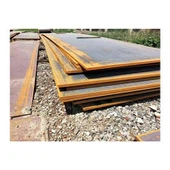
RINA D550 are high-strength marine steel plates specifically designed for use in the construction of ships and other marine vessels. These grades of steel offer excellent strength and durability, making them ideal for use in the demanding marine environment.
Element | RINA D550 Max % | Element | RINA D550 Max % |
C | 0.20 | Ni | 0.40 |
Mn | 1.70 | Mo | 0.08 |
Si | 0.10-0.55 | Al | 0.020 min |
S | 0.030 | Nb | 0.20-0.05 |
P | 0.030 | V | 0.05-0.10 |
Cu | 0.35 | Ti | 0.0007-0.05 |
Cr | 0.20 | N |
|
Crack Sensitivity: Pcm = (C+Si/30+Mn/20+Cu/20+Ni/60+Cr/20+Mo/15+V/10+5B)%
Carbon Equivalent: Ceq = 【C+Mn/6+(Cr+Mo+V)/5+(Ni+Cu)/15】%
RINA D550 extra high strength property in Tempering and Quenching
Grade | Thickness | Yield Strength | Tensile Strength | Elongation | Impact Energy |
(mm) | MPa (min) | MPa | % (min) | (KV J) (min) | |
|
|
|
| -20 degree | |
RINA D550 | 8-260 | 550 | 670-830 | 16 | 37J |
In terms of heat treatment, RINA D550 steel plates are typically supplied in a normalized or quenched and tempered condition. This heat treatment process improves the toughness and fatigue resistance of the steel, further enhancing its suitability for marine use.
Regarding dimensions, RINA D550 steel plates are available in a range of thicknesses, widths, and lengths to meet the specific requirements of various shipbuilding projects. This flexibility allows for the efficient use of material and the customization of structures to suit individual vessel designs.
Impact testing is a crucial aspect of ensuring the safety and reliability of marine steel plates. RINA D550 steel plates undergo rigorous impact testing to assess their resistance to low-temperature brittleness. This testing ensures that the steel plates maintain their toughness and impact strength even in cold environments, which is crucial for ships operating in cold regions or during winter months.
The primary application scenarios for RINA D550 steel plates are in the construction of hulls, decks, and other structural components of ships and marine vessels. Their high strength and corrosion resistance make them suitable for use in both freshwater and saltwater environments. These steel plates are also commonly used in the repair and maintenance of existing ships, extending their service life and enhancing their performance.