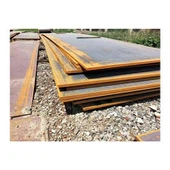
The Grade and Its Thermal History
NM500 is a wear resistant steel plate standardised in GB/T 24186 and delivered at a surface hardness of 470 to 540 HBW. Unlike structural plate, whose properties are largely determined by composition and rolling, the performance of a wear plate is determined by its thermal history. The plate is austenitised, quenched to form a hard martensitic structure, and then tempered to the specified condition before it leaves the mill.
The heat treatment is a single continuous route at the mill, and the delivered plate carries the result of that route as a measurable hardness. Every subsequent thermal operation in a fabrication shop has the potential to change it, which is why the phrase heat treatment in relation to NM500 refers both to how the plate was made and to how it must be handled afterwards.
Quenching and Tempering Practice
Quenching raises the hardness: the plate is heated to the austenitising temperature and cooled at a rate fast enough to avoid the formation of softer transformation products. Tempering then reduces brittleness and internal stress while retaining most of the hardness, provided the tempering temperature is kept well below the level at which the structure begins to soften significantly.
| Treatment stage | Typical parameter | Result |
|---|---|---|
| Austenitising | Around 880 to 920 degrees Celsius, holding to dissolve carbides | Homogeneous austenite ready for quenching |
| Quenching | Rapid cooling above the critical rate | Martensitic structure at maximum hardness |
| Tempering | Low temperature range, controlled soak and cooling | Hardness held in the 470 to 540 HBW band with improved toughness |
| High temperature tempering | Deliberately elevated soak | Softer, machinable delivery state for liners that must be drilled |
When the plate is tempered at a high temperature, the carbides coalesce into a coarser distribution and the resulting tempered structure machines and cuts far more easily than the hard quenched state. This high temperature tempered condition is used when a wear liner has to be drilled, counterbored or milled before installation, and the wear performance is accepted as a trade for the improved machinability.
How Later Heating Affects Wear Life
Any process that raises the plate temperature close to or above the original tempering temperature softens the affected zone. The softened band may be only a few millimetres wide, but in an abrasive stream that band wears quickly and can undercut the surrounding plate, so the practical rule in wear plate fabrication is to keep heat input low and local.
Flame and plasma cutting: heat input is limited and the cut edge is inspected for excessive softening or hardening.
Welding: small fillet or partial penetration joints are preferred, with a controlled interpass temperature.
Flame straightening: avoided on wear plate, because concentrated local heating softens a strip of the wear surface.
Post weld heat treatment: not normally applied to wear plate, as it would reduce the delivered hardness.
Supply Range, Delivery State and Stock Practice
NM500 is stocked across a broad thickness range, typically from 3 mm to 150 mm, with hardness guaranteed on each plate and reported on the mill test certificate. Plate can be supplied in full sizes, in cut to length dimensions, or as finished liners cut to a customer drawing. For liners that require drilling, a softer delivery state can be ordered so that conventional tooling is sufficient.
Buyers who compare offers on price alone often overlook the delivery state and the hardness range on the certificate. Two plates at nominally the same grade can differ in flatness, in surface condition and in the position of hardness testing, and those differences affect both installation time and wear life. Ordering against a defined hardness window, a defined thickness tolerance and a defined flatness requirement is the reliable way to compare suppliers.
Inspection and Fabrication Control
Incoming inspection of wear plate usually includes verification of the certificate, hardness measurement with a portable tester at several points, dimensional and flatness checking, and visual inspection for surface defects. For heavy duty liners, ultrasonic examination can be specified to confirm internal soundness. In fabrication, the cutting plan is laid out so that the direction of rolling and the position of the wear surface are known, and drilled holes are produced in the softened condition before installation wherever possible.
In service, wear plate is normally inspected on a scheduled basis at the highest wear points, which in most plants are the impact zone of a transfer chute, the discharge lip of a hopper and the bucket heel of a loading machine. Recording thickness at fixed reference points allows replacement to be planned rather than reactive, and it provides the data needed to decide whether a higher hardness grade or a thicker plate would reduce total cost.
Frequently Asked Questions
Q: What hardness is guaranteed on an NM500 plate?
A: GB/T 24186 specifies 470 to 540 HBW at the plate surface, and the value is measured and reported for each plate.
Q: Does welding reduce the wear resistance of NM500?
A: Yes. The heat affected zone softens relative to the parent plate, so welds are kept small and local, and heat input is controlled.
Q: Why is a softened delivery state sometimes supplied?
A: Because drilling, counterboring and milling are impractical in the hard quenched condition, so a high temperature tempered state is used when the liner must be machined.
Q: Can NM500 be flame straightened?
A: Concentrated flame heating should be avoided on the wear surface, since it locally tempers and softens the plate.
Q: Is post weld heat treatment used on wear plate?
A: It is not normal practice, because a full heat treatment cycle would reduce the delivered hardness that governs wear life.
Q: What thickness range is available?
A: Abrasion resistant plate is commonly stocked from 3 mm to 150 mm, with fabricated liners usually between 6 mm and 60 mm.