



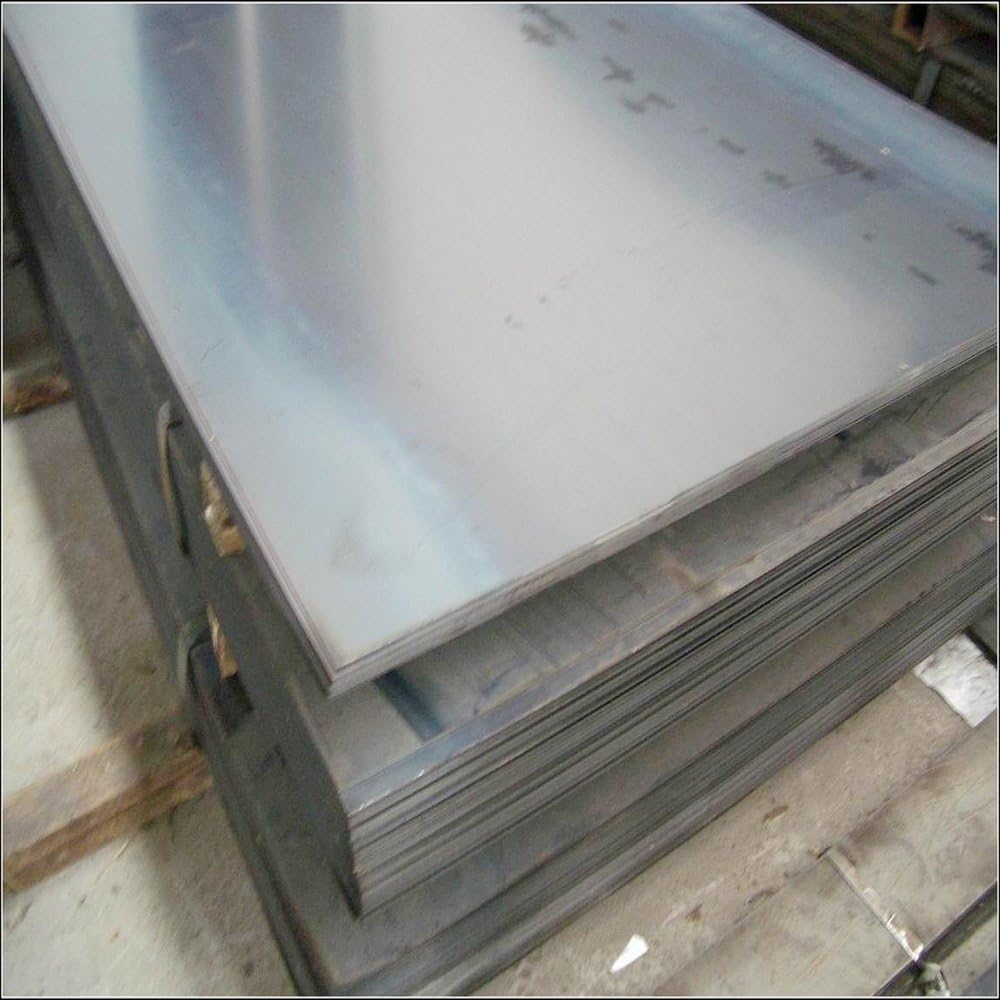
P235GH Steel Plate Product Overview
P235GH steel plate is a European pressure vessel grade (EN 10028-2, Material No. 1.0345) designed for boiler and pressure equipment operating at moderately elevated temperatures. As a non-alloy, aluminum-killed, fine-grain steel, it provides a proven combination of strength, toughness, and fabricability that makes it suitable for a wide range of pressure-bearing components.


Key Characteristics
Low carbon equivalent (typical CEV ~0.35–0.41) - excellent weldability
Fine-grain structure via aluminum deoxidation - consistent toughness
Good cold formability - suitable for pressing, bending, and flanging
Elevated-temperature strength - Rp0.2 data available up to 400°C
Low-temperature toughness - 27 J at -20°C (transverse)
Density: 7.85 g/cm³
P235GH Carbon Steel Plate chemical composition
| Element | Content (wt%) | Element | Content (wt%) |
|---|---|---|---|
| Carbon (C) | ≤ 0.16 | Chromium (Cr) | ≤ 0.30 |
| Silicon (Si) | ≤ 0.35 | Copper (Cu) | ≤ 0.30 |
| Manganese (Mn) | 0.60 – 1.20 | Molybdenum (Mo) | ≤ 0.08 |
| Phosphorus (P) | ≤ 0.025 | Nickel (Ni) | ≤ 0.30 |
| Sulfur (S) | ≤ 0.015 | Niobium (Nb) | ≤ 0.020 |
| Aluminum (Al, total) | ≥ 0.020 | Titanium (Ti) | ≤ 0.030 |
| Nitrogen (N) | ≤ 0.012 | Vanadium (V) | ≤ 0.020 |
P235GH pressure vessel plate mechanical property
| Thickness (mm) | Yield ReH (MPa, min) | Tensile Rm (MPa) | Elongation A (%) | KV at -20°C (J, trans.) | KV at 0°C (J, trans.) | KV at +20°C (J, trans.) |
|---|---|---|---|---|---|---|
| ≤ 16 | 235 | 360 – 480 | ≥ 24 | ≥ 27 | ≥ 34 | ≥ 40 |
| > 16 to ≤ 40 | 225 | 360 – 480 | ≥ 24 | ≥ 27 | ≥ 34 | ≥ 40 |
| > 40 to ≤ 60 | 215 | 360 – 480 | ≥ 24 | ≥ 27 | ≥ 34 | ≥ 40 |
| > 60 to ≤ 100 | 200 | 360 – 480 | ≥ 24 | ≥ 27 | ≥ 34 | ≥ 40 |
| > 100 to ≤ 150 | 185 | 350 – 480 | ≥ 24 | ≥ 27 | ≥ 34 | ≥ 40 |
| > 150 to ≤ 250 | 170 | 340 – 480 | ≥ 24 | ≥ 27 | ≥ 34 | ≥ 40 |
P235GH Steel Plate for Boiler & Pressure Vessels Specification
| Parameter | Specification |
|---|---|
| Thickness range | 5 – 300 mm (mechanical properties per EN 10028-2 defined to 250 mm) |
| Standard width | 1,500 – 4,050 mm |
| Standard length | 3,000 – 18,000 mm |
| Delivery condition (standard) | +N (Normalized at 890–950°C) |
| Delivery condition (optional) | +AR (As-rolled, by agreement) |
| Thickness tolerance | EN 10029 - Class B (default), other classes available |
| Surface quality | EN 10163-2 - Class B (default) |
| Ultrasonic testing | EN 10160 - Class B/C/D upon request |
| Additional testing | HIC (NACE TM0284), Z15/Z25/Z35 (EN 10164), NACE MR0175/MR0103 |
| Certification | EN 10204 3.1 MTC (3.2 with third-party witness available) |
We maintain rolling schedules for P235GH in thicknesses from 5 mm to 300 mm with widths up to 4,050 mm. Custom dimensions and project-based quantities are welcome.
Corrosion Behavior & Environmental Considerations--P235GH Plate
P235GH, as a non-alloy carbon steel, exhibits predictable corrosion behavior that fabricators and plant operators must account for in design and maintenance planning:
Atmospheric exposure: P235GH corrodes at a rate of approximately 0.05–0.10 mm/year in rural atmospheres, 0.10–0.20 mm/year in industrial/marine atmospheres, and 0.20–0.50 mm/year in severe marine environments. Corrosion allowance (typically 1–3 mm) is added to calculated wall thickness in vessel design per EN 13445 or ASME VIII to account for service life degradation.
Aqueous environments: In neutral water (pH 6–10), corrosion rates are generally low (<0.1 mm/year) in the absence of dissolved oxygen. Deaerated boiler feedwater minimizes corrosion in steam systems. In acidic or alkaline media, corrosion rates increase significantly, and internal linings or coatings become essential.
Sour service (H₂S): P235GH is suitable for sour service environments when supplied to NACE MR0175/MR0103 specifications with controlled sulfur content (≤0.015%) and HIC testing per NACE TM0284. The steel's low carbon content and clean steelmaking practices support resistance to hydrogen-induced cracking and sulfide stress cracking.
High-temperature oxidation: At temperatures above 400°C, the oxide scale formation rate increases progressively. For components operating near the 400°C limit, aluminide diffusion coatings or stainless steel cladding may be applied to extend service life.
Hydrogen attack: At elevated temperatures and high hydrogen partial pressures, Nelson curves (API 941) define the safe operating limits for carbon steel. P235GH is generally suitable for hydrogen service below approximately 200°C at any pressure, and at higher temperatures only at low hydrogen partial pressures. For more demanding hydrogen service, Cr-Mo grades such as 16Mo3 are preferred.
P235GH Steel Plate Typical Applications
- Power generation: Boiler drums, headers, steam piping
- Oil & gas: Separators, storage tanks, heat exchangers
- Petrochemical: Distillation columns, reactors, pressure vessels
- Chemical: Storage vessels, process equipment
- General engineering: Pressure piping, structural pressure parts

Why Choose GNEE Steel?
In-House QC & Quality Assurance
Our dedicated quality control team conducts full-process inspections spanning raw materials, hot rolling, leveling, and final factory dispatch. We strictly monitor dimensional tolerances and surface quality to eliminate defects such as surface cracking, slag inclusions, and oxidation rust.
Advanced Production Infrastructure
Equipped with international high-precision rolling mills and over 20 advanced production lines dedicated to CNC cutting and surface treatment.
Flexible Export Logistics & Protective Packaging
We offer tailor-made shipping solutions-including Full Container Load (FCL), Less than Container Load (LCL), and cross-border road freight-to optimize logistics costs. Plates are treated with surface protective film and heavy-duty anti-rust export packaging to prevent seawater corrosion and surface scratching during ocean transit.


Not sure if P235GH is the right grade for your application? Our metallurgical team can help you select the optimal EN 10028 grade.
FAQ
Q: What is the maximum thickness for P235GH plates?
A: EN 10028-2 defines mechanical properties up to 250 mm. Production capability depends on the mill - typical availability ranges from 5 mm to 300 mm.
Q: Does P235GH require post-weld heat treatment (PWHT)?
A: PWHT is not always mandatory for P235GH. For thicknesses above approximately 30 mm, or when service conditions involve thermal cycling or sour environments, PWHT at 580–620°C is recommended. The specific requirement should be determined per the applicable design code (e.g., EN 13445, ASME VIII).
Q: What is the difference between P235GH and P235NL1?
A: P235GH (EN 10028-2) is designed for elevated-temperature service with impact testing down to -20°C. P235NL1 (EN 10028-3) is a normalized fine-grain steel for low-temperature service with impact testing down to -50°C. They serve different design scenarios and are not interchangeable.
pressure vessel plate material Products image


GNEE group team photo

GNEE group customer visit


GNEE Group steel exhibition


We have professional online service staff. If you have any questions about P235GH Steel Plate For Boiler, please send us an inquiry and we will reply you within one working day.
Hot Tags: P235GH Steel Plate for Boiler & Pressure Vessels – Composition, Properties & Applications, China P235GH Steel Plate for Boiler & Pressure Vessels – Composition, Properties & Applications manufacturers, suppliers, factory, P460Q P460QH Steel Boiler Plate, P265GH Steel Plates, Boiler Steel, P355NL1 P355NL2 Boiler Steel Plate, P355GH P460NH Vessel Plate, Pressure Vessel Steel Plate


